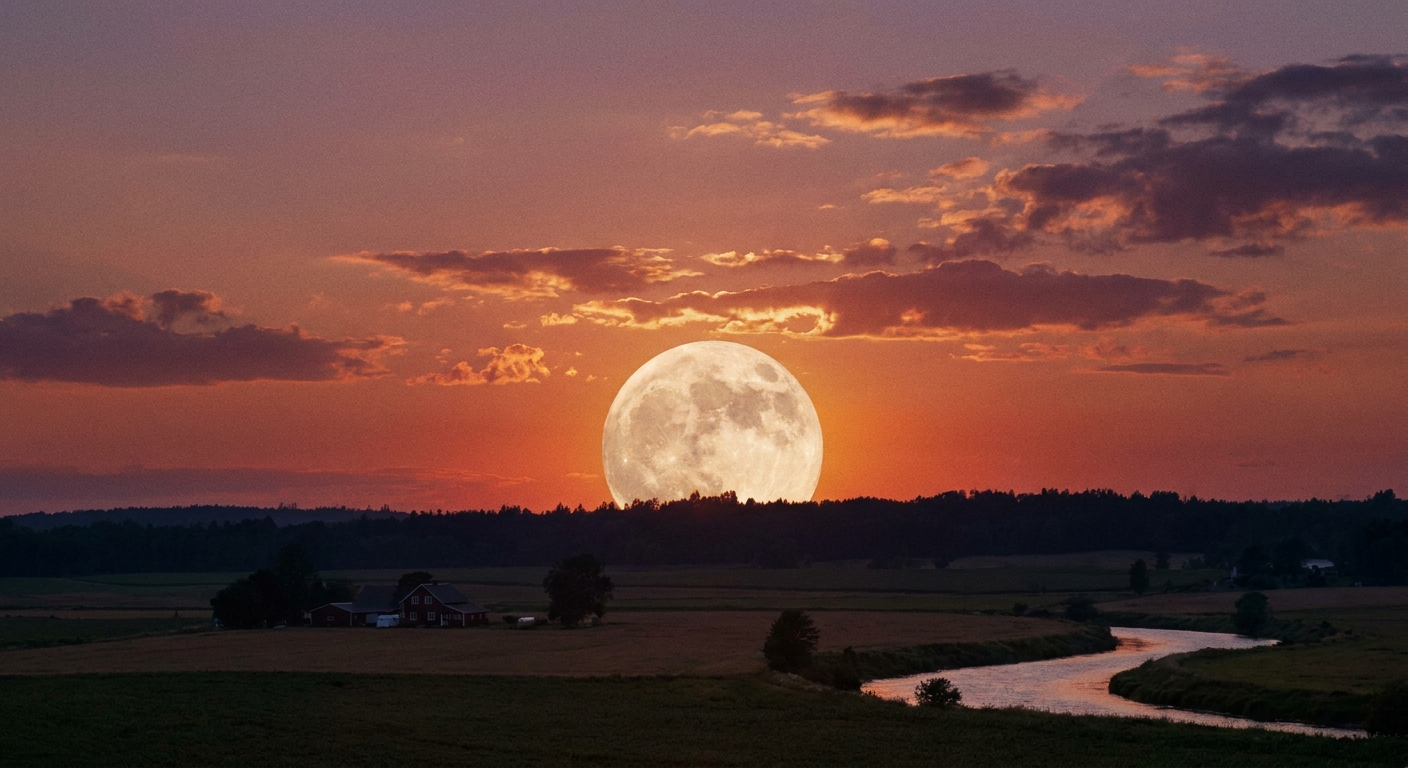
Every so often, the Moon pulls off a magic trick: it rises over the trees or city skyline and suddenly looks like a glowing beach ball you could roll down the street. Then, an hour later, it is higher up and feels… normal again. Your eyes are not broken, your camera is not lying, and the Moon is not doing any last-minute shape-shifting. This is a classic perception quirk called the moon illusion, and it happens because your brain is trying to be helpful.
The quick truth
The Moon’s angular size in the sky is almost constant whether it is near the horizon or high overhead. (A useful anchor: it is about 0.5°, roughly the width of your pinky fingernail at arm’s length.) What changes is the context your brain uses to judge size.
Think of it like listening to the same song on two different speakers. The audio file is identical, but the experience changes because the system around it changes. Near the horizon, the Moon comes with “extra equipment”: buildings, trees, mountains, haze, and a big sweep of landscape that your visual system interprets as distance.
Why it looks bigger at the horizon
One important note up front: researchers still debate the exact mix of mechanisms behind the moon illusion. Distance cues and context are major contributors, but there is not a single universally accepted explanation that wins in every situation.
1) Distance cues and the sky-dome problem
Your brain constantly estimates distance. It does this so you can catch a ball, step off a curb, or pour coffee without decorating your shoes. The trouble is that the sky is not a solid surface with obvious depth markers. So your brain builds a model anyway, and it often treats the sky like a dome that feels closer overhead and farther toward the horizon.
In that model, the horizon can feel farther away than the sky overhead, because you are looking “across” the world instead of “up” at it. If your brain decides the horizon sky is farther, but the Moon is still producing roughly the same size image on your retina, the brain’s size-distance logic can kick in:
- Same retinal size + seems farther away = must be bigger
This is a normal mental shortcut. It is the same reason a person across a football field does not feel like a tiny toy. Your brain automatically corrects for distance. It just happens to overcorrect for the Moon near the horizon.
2) Scale from foreground objects
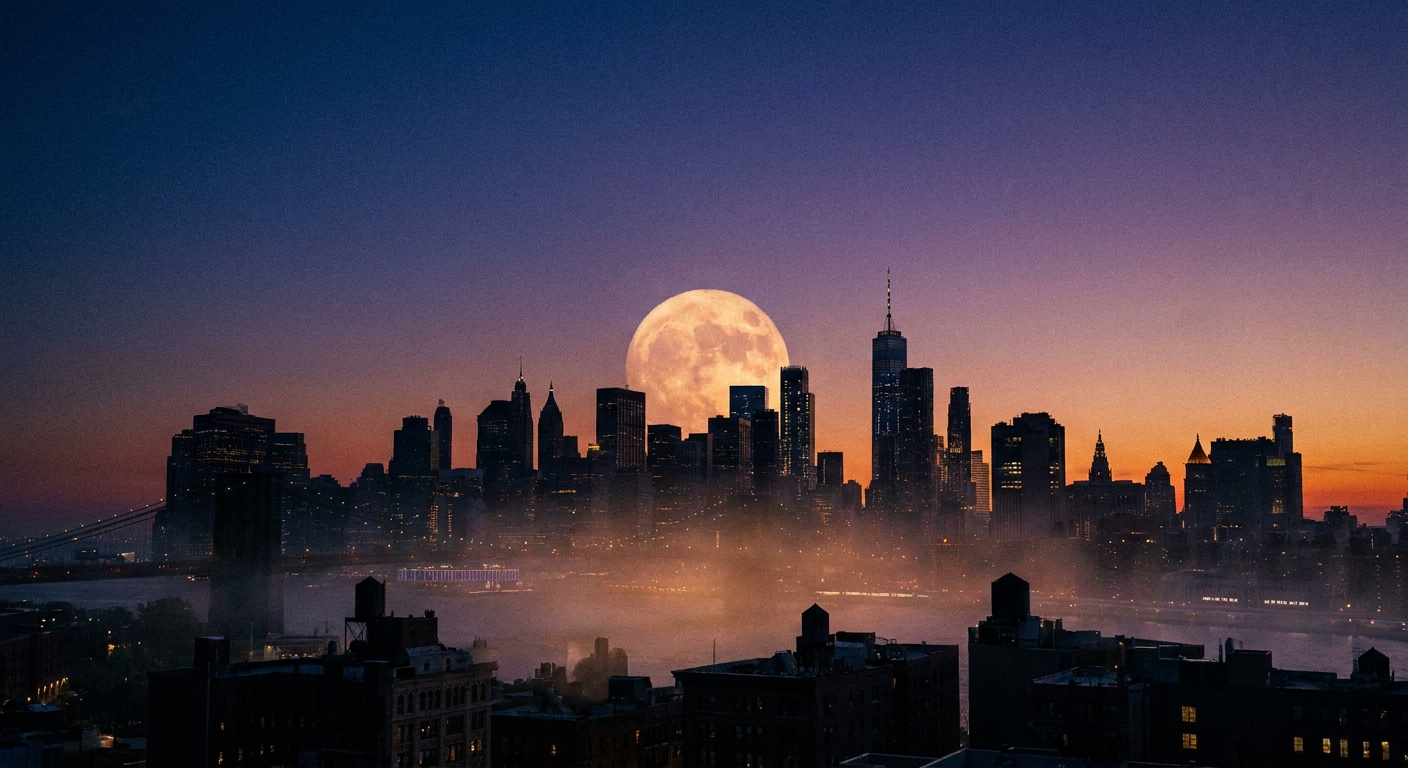
Near the horizon, the Moon hangs out next to useful measuring sticks: trees, rooftops, telephone poles, ridgelines. Your brain loves comparisons. When the Moon is high in the sky, it is floating in a mostly empty background, and you lose those easy references.
So the Moon near the horizon can feel larger because your visual system is doing what it always does: judging one thing by placing it among other things.
3) Atmosphere can boost the impression
The lower the Moon is, the more atmosphere its light passes through. That extra air can soften edges, tint the Moon orange, and reduce contrast in the surrounding sky, especially near sunrise or sunset. That softer, warmer look can make the Moon feel more “present,” which can amplify the illusion.
Atmosphere is not the main cause of the moon illusion, but it can help the effect land. Like good stage lighting, it makes the trick more convincing.
Try this quick test
You can demonstrate the key idea, that your brain’s size judgment depends on context, with a simple experiment:
- Step 1: Next time the Moon looks huge near the horizon, hold your thumb and forefinger at arm’s length and pinch the Moon between them.
- Step 2: Remember how wide that “pinch” is.
- Step 3: Later, when the Moon is higher, do the same pinch again at the same arm’s length.
You will find the pinch width is essentially the same, even if your gut insists the Moon shrank.
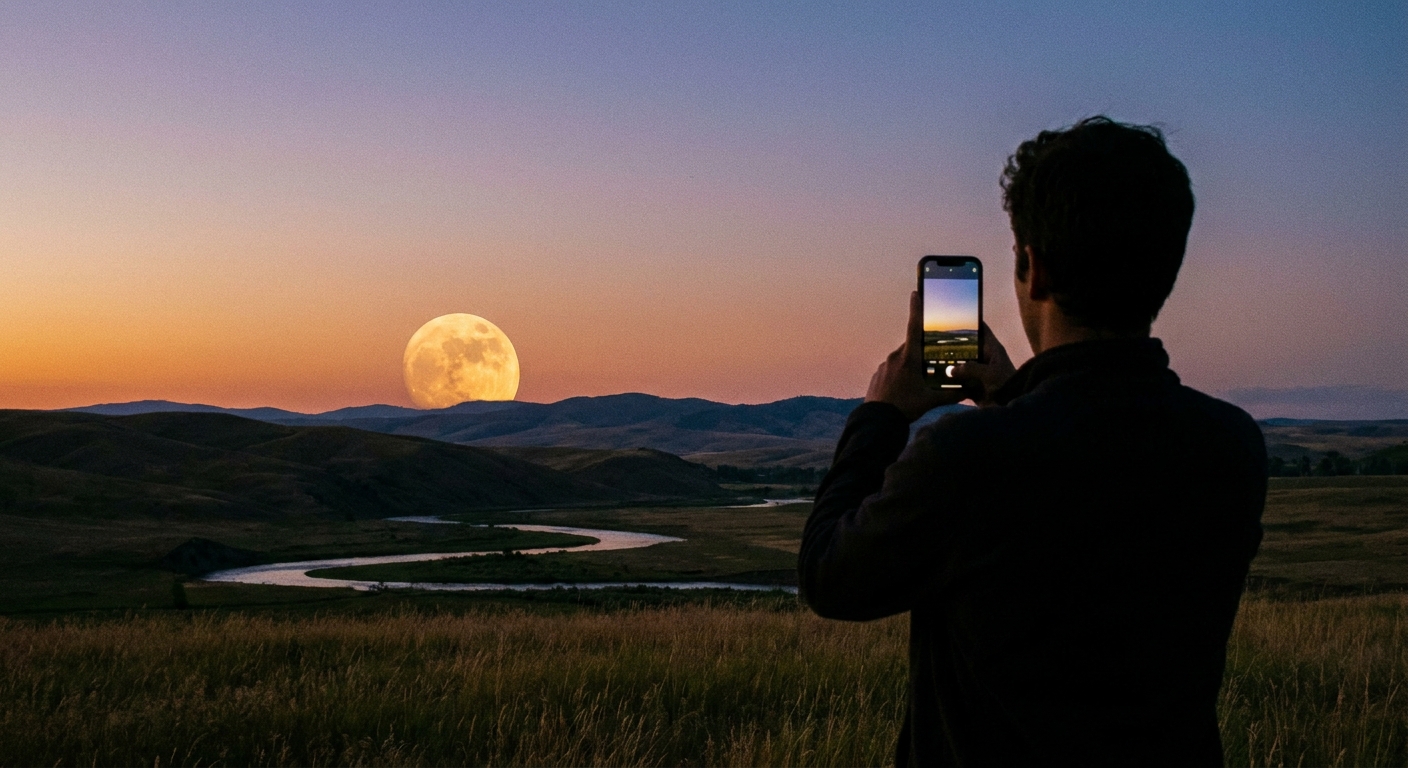
If you want another version: look at the horizon Moon through your phone camera and then look at it with your eyes. The phone often shows the Moon’s angular size more consistently because it strips away some of the depth cues your brain relies on. One caveat: lens choice matters. A wide-angle phone shot can make the Moon look tiny relative to the landscape, while a zoom or long lens can make it look impressively large in the frame.
Does the Moon really change size?
Not in the way the illusion suggests. The Moon’s physical diameter does not change, and its apparent angular size does not change enough over the course of a single evening to explain the dramatic “wow” effect.
There are real effects that change the Moon’s apparent size a little, but they are modest compared with the illusion:
- Orbital distance: The Moon’s orbit is slightly elliptical. When it is closer to Earth (perigee), it looks larger than when it is farther (apogee). The swing is about 14% overall (roughly 29.3 to 34.1 arcminutes). This is the basis of the popular “supermoon” idea, but it is still subtle compared with the horizon illusion.
- Observer position (parallax): As Earth rotates, your position shifts slightly, which changes your viewing geometry to the Moon by a tiny amount. The resulting angular-size change is very small, and again not the big-Moon moment people notice near the horizon.
- Atmospheric refraction and distortion: Near the horizon, the atmosphere can distort the Moon’s shape, sometimes making it look a bit squashed vertically. This is more about shape than size, and it does not explain the “giant Moon” feeling.
So if the Moon looks enormous over the ocean and then “shrinks” as it rises, that is your brain doing brain things, not the Moon inflating like a balloon.
Why it feels so convincing
The moon illusion sticks because it is built on the same machinery that usually serves you brilliantly. Your brain uses context, comparisons, and distance cues to make fast, practical judgments in a 3D world. The sky just happens to be a weird place to apply those tools.
In the classroom, I used to tell students: perception is not a camera feed. It is a best guess. The horizon Moon is one of the friendliest reminders that your mind is constantly interpreting, not merely receiving.
FAQ
Can I make the illusion go away?
Often, yes. Try viewing the Moon upside down by bending over, or look at it through your legs. This can reduce the brain’s landscape context and make the Moon look more normal. Looking through a camera can have a similar effect.
Is the Moon bigger in winter or during a full Moon?
The illusion can feel stronger when the Moon is low and near lots of horizon features, which can happen in different seasons depending on your latitude and the Moon’s path. A full Moon is also bright and attention grabbing, so you are more likely to notice the effect. But the underlying illusion is not limited to any one season or phase.
Why does the Moon look yellow or orange near the horizon?
When the Moon is low, its light travels through more air. Shorter blue wavelengths get scattered more along the way (plus aerosols and dust can add extra filtering), so the light that reaches you is often warmer in color. The color is real, but it is not the main reason the Moon looks bigger.
Why do photos not always match what I saw?
Your eyes and brain add context-based interpretation. A camera mostly records angles and brightness. On top of that, focal length changes the composition: wide-angle shots make the Moon small relative to the scene, while a zoom or long lens makes it look larger against foreground objects.