Curiosity, with all its quills showing.
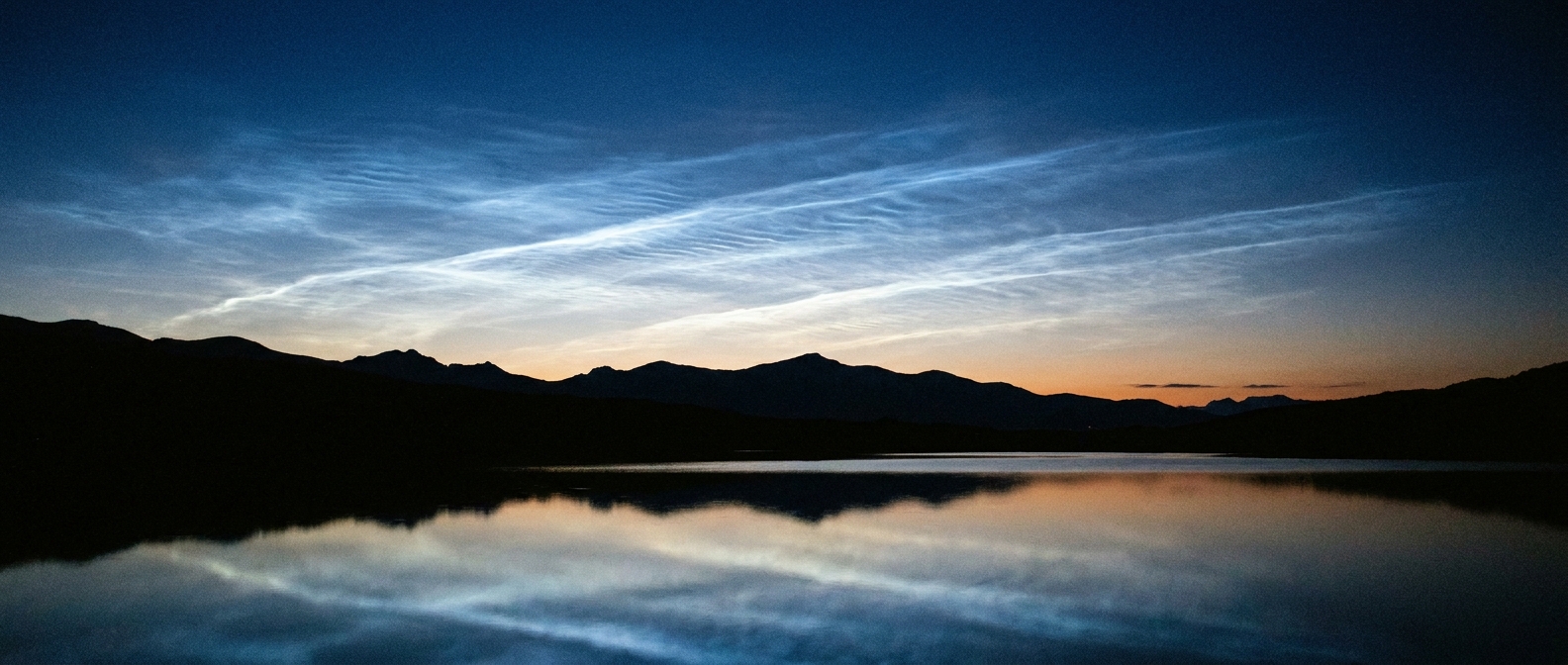
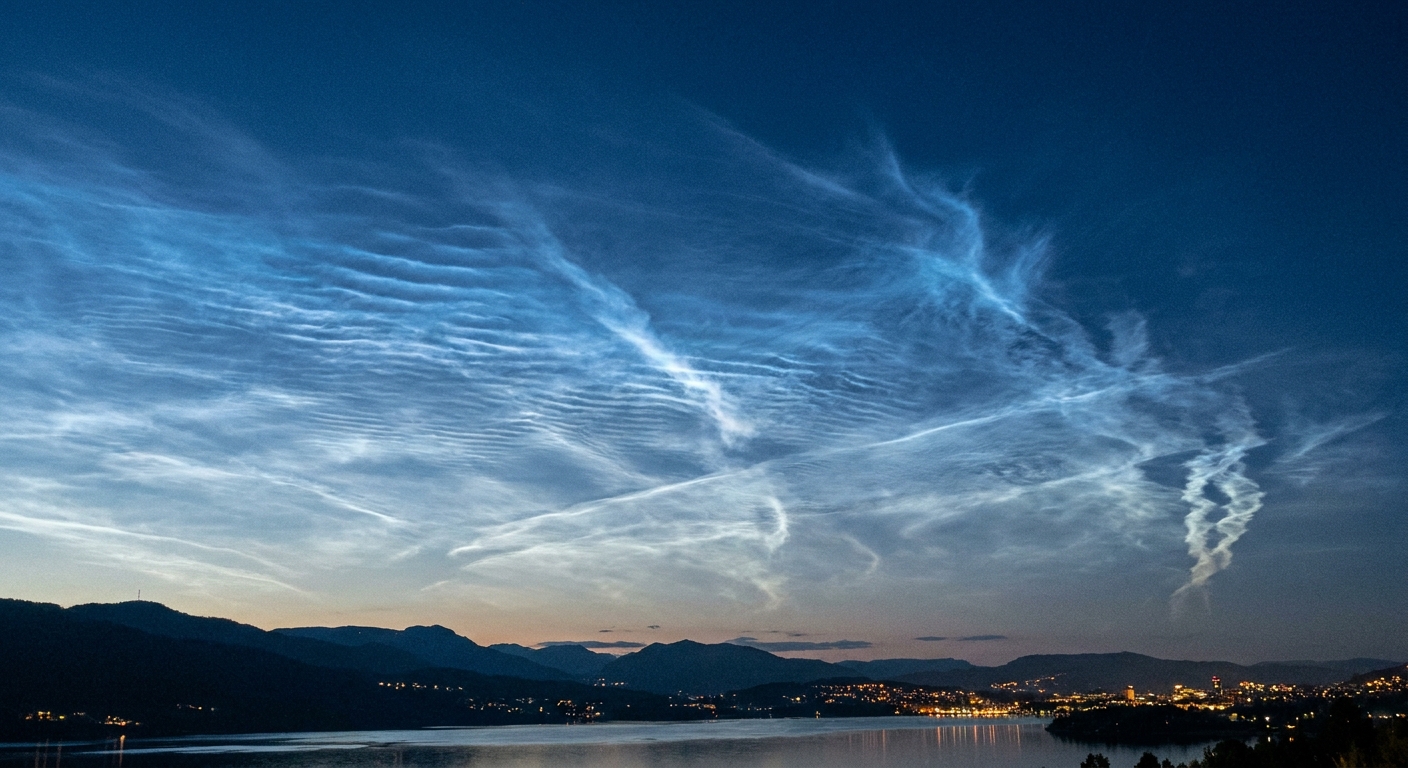
Some evenings, long after sunset has packed up its brighter colors, the sky offers a surprise encore: delicate, silvery-blue filaments that look like they were brushed on with light. Those are noctilucent clouds, and they are unusual not because they emit light, but because they sit so high above us that they can still catch sunlight when the lower atmosphere is already in Earth’s shadow.
The quick definition
Noctilucent clouds are thin clouds of ice crystals that form in the upper mesosphere, roughly 80 to 85 kilometers (about 50 to 53 miles) above Earth’s surface. That is far higher than ordinary weather clouds, which live in the troposphere, typically within the lowest 8 to 18 kilometers (about 5 to 11 miles), depending on latitude and season.
The name is a tidy clue: nocti for night, lucent for shining. They are also called polar mesospheric clouds because they favor high latitudes and the mesosphere.
Why they glow after sunset
Noctilucent clouds do not generate light the way auroras do. They look bright because of geometry.
- After sunset, the lower atmosphere and most familiar clouds are inside Earth’s shadow, so they go dark.
- Noctilucent clouds sit much higher, well above weather and still below the 100-kilometer Kármán line, where they can remain sunlit while your local sky has already dimmed.
- From the ground, you see sunlit ice crystals against a darkened sky, which makes the clouds appear to glow.
This is why sightings cluster around twilight. If the Sun is too high, the bright daytime sky washes them out. If the Sun is too far below the horizon, even the mesosphere loses that last reach of sunlight.
Where they form: the summer mesosphere
There is a striking contradiction at the heart of noctilucent clouds: they are ice clouds in summer. That sounds backwards until you remember that seasons in the mesosphere behave differently than seasons at the surface.
In the summer polar mesosphere, circulation patterns help create extremely cold temperatures, cold enough for water vapor to freeze into tiny ice crystals. But cold alone is not enough. The atmosphere up there is also extremely thin, so the ingredients have to meet just right:
- Water vapor, supplied by upward transport and atmospheric chemistry, including contributions from methane oxidation.
- Very cold temperatures in the upper mesosphere, especially at high latitudes in summer.
- Seeds for ice to form on, likely including tiny particles such as meteoric smoke, the fine dust left behind as meteoroids ablate in the atmosphere.
When those pieces come together, the result is a veil of ice crystals that can scatter sunlight efficiently, producing that pearly, electric look.
When to see noctilucent clouds
Season
They are most common in late spring and summer at higher latitudes.
- Northern Hemisphere: most often from late May through August, with peak chances around June and July.
- Southern Hemisphere: most often from late November through February.
Time of night
The sweet spot is usually deep twilight, when the Sun is below the horizon but not too far down. If you like a simple rule, look when the Sun is roughly 6° to 16° below the horizon (late civil through nautical twilight). In practical terms, that often means:
- After sunset, commonly about 30 to 90 minutes later, depending on latitude and season.
- Before sunrise, in the comparable window of morning twilight.
They tend to appear low in the sky toward the twilight glow. In the Northern Hemisphere, that often means scanning north to northwest after sunset and north to northeast before sunrise, though it varies with your location and the night’s geometry.
Where they appear on Earth
Noctilucent clouds are most commonly seen from high latitudes, especially around 50° to 65° north or south, with frequent reports extending toward about 70°. That includes much of Canada, Alaska, northern Europe, and parts of the northern United States on the lower end of the range.
On particularly favorable nights, they can be spotted farther from the poles than usual. If you are closer to mid-latitudes, you are not doing anything wrong if you rarely see them. You are simply outside their most reliable zone.
What do they look like?
Noctilucent clouds can look like:
- Silvery or electric-blue threads
- Ripples and wave trains, like wind patterns on sand
- Wispy nets or braided streaks
- Sharp-edged luminous bands that seem too crisp to be ordinary cloud
They are also notably high and apparently motionless compared with lower clouds, although their patterns can evolve over minutes as winds shift in the mesosphere.
How to spot them
- Pick a clear view of the horizon in the direction of twilight, away from trees and buildings.
- Look during deep twilight, not full dark and not bright sunset.
- Use your eyes first. A camera can help, but noctilucent clouds are often visible unaided when conditions cooperate.
- Try a phone photo in night mode if you are unsure. Noctilucent clouds often show up as pale, structured streaks, while ordinary haze looks mushy.
If you see something that looks like a glowing, finely textured veil, check whether lower clouds are dark. That contrast is one of the best clues that the bright stuff is very high.
One extra tell, if you are on the fence: twilight cirrus can look pretty, but it is lower and usually less finely etched. If the bright pattern fades quickly as twilight deepens while other clouds are already dark, it was probably ordinary cloud catching the last light. Noctilucent clouds often hold their crisp, silvery structure a little longer into the dim.
Why reports seem more common lately
If it feels like noctilucent cloud photos pop up more often than they used to, there are a few straightforward reasons you can trust without needing any single, dramatic explanation.
1) More eyes and better cameras
Twilight skywatching has a larger audience now, and modern phone cameras are remarkably good at capturing faint, high-contrast patterns. A phenomenon that once required luck plus a decent camera can now be documented quickly and shared widely.
2) Better forecasting and awareness
There is greater public awareness of noctilucent clouds, and more communities and organizations track upper-atmosphere conditions that favor them. When people know what to look for, they find it.
3) A real atmosphere that changes
The mesosphere is not static. Temperature, water vapor availability, and the tiny particles that help ice form can vary year to year. Researchers continue to investigate how longer-term climate trends might influence conditions in the upper atmosphere. The cautious takeaway is this: changes in the mesosphere can affect noctilucent cloud frequency and brightness, and the science community is actively studying those links.
Not the same as these
Polar stratospheric clouds form much lower, in the stratosphere during winter, and are closely tied to very cold air and ozone chemistry.
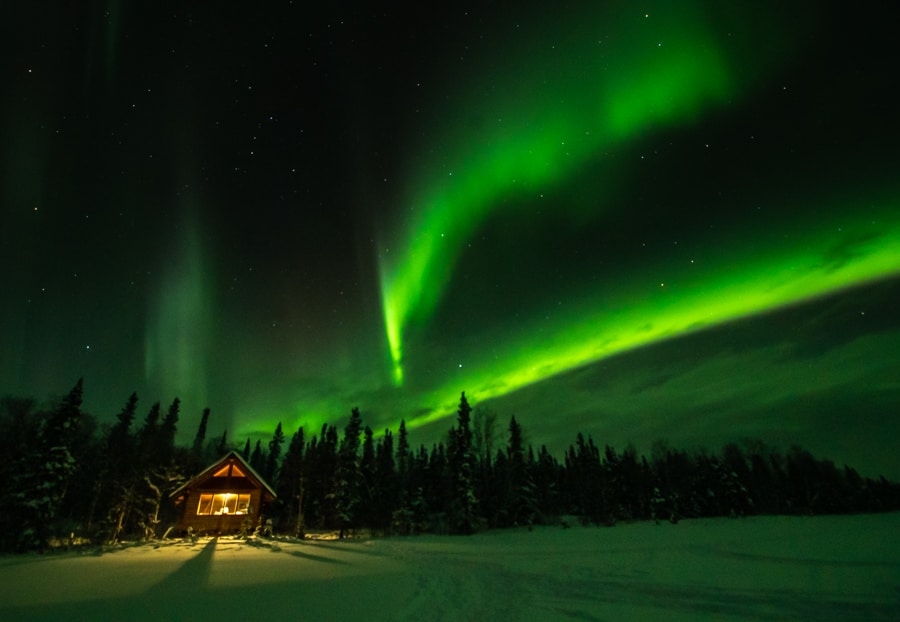
Auroras are light emissions produced when charged particles from space excite gases in the upper atmosphere, not sunlight reflecting off ice crystals.
FAQ
Are noctilucent clouds dangerous?
No. They are far above weather, aircraft routes, and anything we experience at the surface. They are a sign of conditions in the upper atmosphere, not a hazard.
Do they mean a storm is coming?
Noctilucent clouds are not connected to local storm development. They form in the mesosphere, while storms live in the troposphere.
Why are they often blue?
The blue tint is related to how small ice crystals scatter sunlight and how twilight light passes through the atmosphere. The exact color you perceive also depends on the Sun’s angle, your sky conditions, and light pollution.
Can you see them from cities?
Sometimes, yes. But light pollution and haze can wash out the faintest structures. A darker sky and a clear horizon make the odds better.
A final look up
Noctilucent clouds are one of those atmospheric reminders that Earth has layers, each with its own physics, its own seasons, and its own small surprises. If you ever spot that silver-blue lace lingering in twilight, you are watching sunlight touch ice high in the upper atmosphere while the air around you has already turned to night.