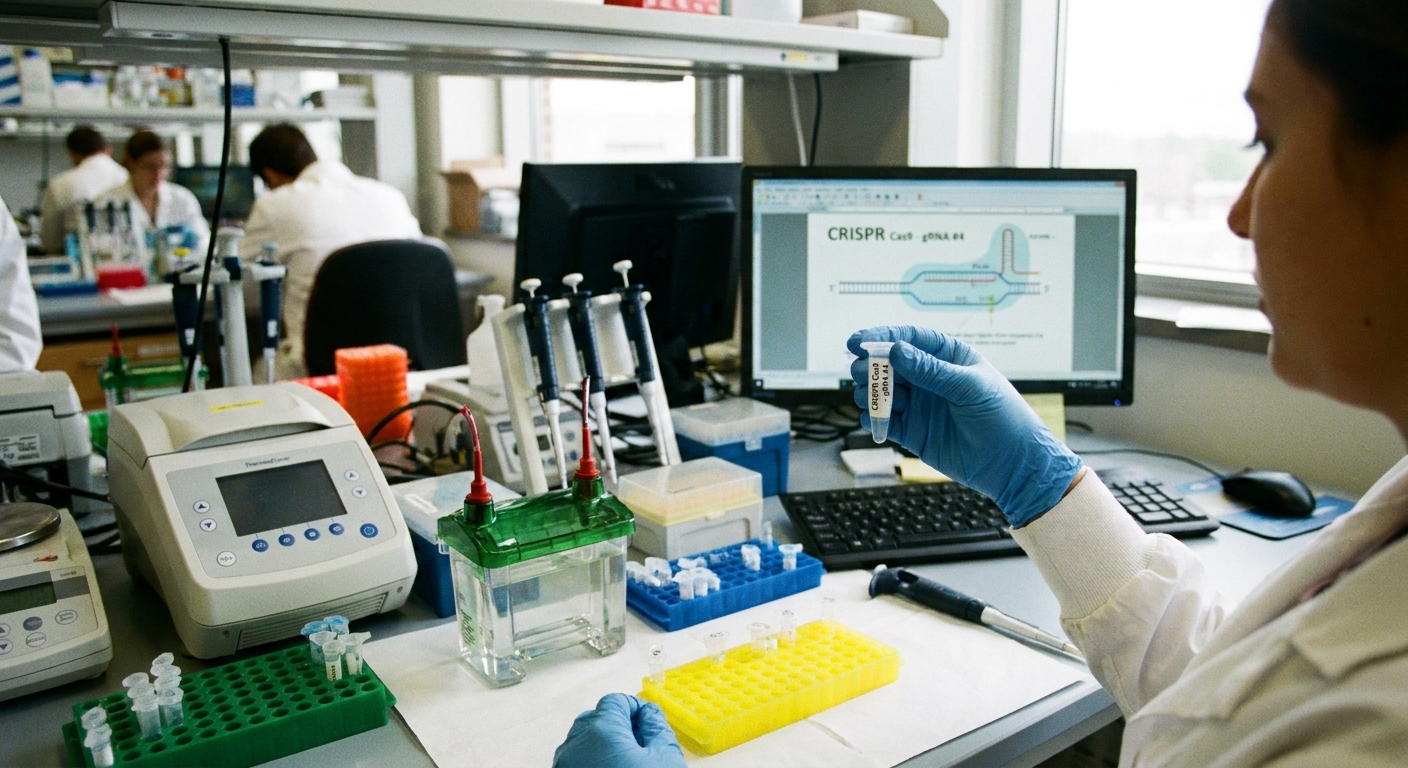
Gene editing sounds like science fiction, but inside a cell it is closer to a very careful repair job. A tool like CRISPR does not “rewrite your whole genome.” It does something more specific: it locates a particular DNA sequence, triggers a change at that spot, and then the cell’s own repair machinery finishes the job.
To make sense of it, it helps to think in three big steps: find the address in DNA, edit the DNA at that address, and repair the DNA so the cell can keep living and copying that information.
First, a quick DNA refresher
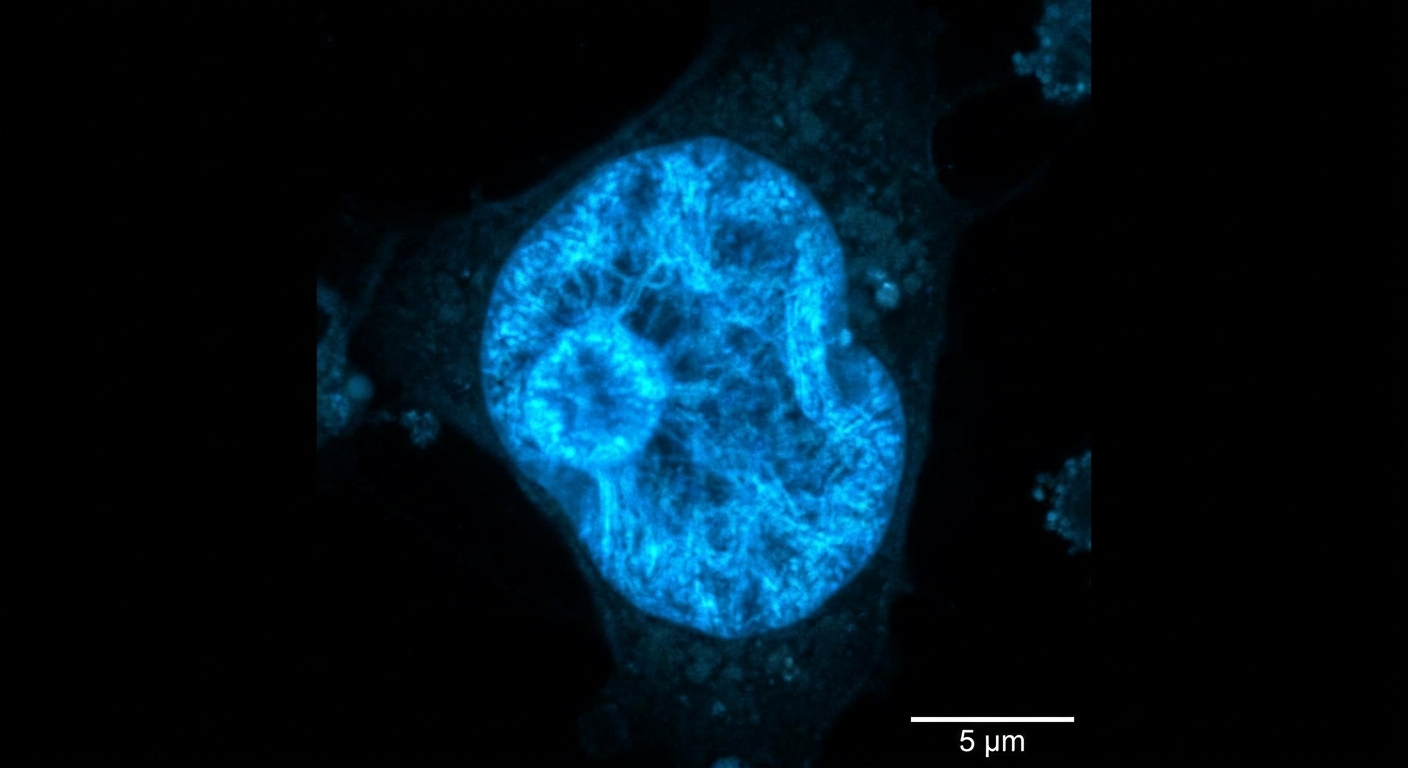
DNA is a long molecule packed into chromosomes. You can picture it as a cookbook written in a four letter alphabet (A, T, C, G). A gene is a stretch of that text that helps a cell build a particular protein or RNA. But genes are not the whole story. Surrounding DNA also contains “control switches” that turn genes up, down, on, or off in different cell types.
So when scientists talk about gene editing, they might mean:
- Changing the recipe (altering the gene’s coding sequence).
- Changing the switches (tweaking regulatory DNA that controls when a gene is active) .
- Changing a single letter (a point mutation).
- Inserting or removing a chunk (adding or deleting DNA).
Step 1: How CRISPR finds the right spot
CRISPR is often explained as “molecular scissors,” and that is not wrong. But the truly impressive part is the GPS: the targeting system that brings the tool to one location in the genome.
The most common CRISPR system used in labs pairs:
- Cas9 (a protein that can cut DNA), and
- a guide RNA (a short RNA sequence that tells Cas9 where to go).
The guide RNA is designed to be complementary to a target DNA sequence in the genome. Inside the cell, the Cas9 protein holds onto the guide RNA and searches along DNA until it finds a strong enough match. Because biology is messy, Cas9 can sometimes tolerate certain mismatches or other imperfect alignments, which is one reason off-target activity is possible.
The “PAM” requirement (a built-in constraint)
Cas9 does not stop at just any matching sequence. Many Cas9 versions also require a short nearby DNA motif called a PAM (protospacer adjacent motif). You can think of PAM as a little “permission stamp” next to the address. Without the right PAM next to the target, Cas9 will not bind and cut efficiently.
This detail matters because it constrains where a given Cas9 can operate and can reduce accidental cutting, although it does not eliminate it.

Step 2: The edit itself: cutting, nicking, or writing a change
Once CRISPR is docked at the target site, different tools can make different kinds of changes. Not all gene editing is the same kind of “cut.”
Classic CRISPR: a double-strand break
In the classic approach, Cas9 cuts both strands of the DNA helix at the target location. That creates a double-strand break, which is a serious problem for the cell. A broken chromosome is dangerous, so the cell rushes to repair it.
The important point: CRISPR makes the break, but the cell decides how the break gets repaired, and that repair outcome is where the real “editing” happens.
Base editing: changing one letter without cutting both strands
Sometimes you do not want scissors at all. Base editors are modified CRISPR systems that can convert one DNA letter to another (for example, changing a C to a T) at a targeted site. They typically use a Cas protein that nicks one DNA strand and avoid making a full double-strand break.
That can be useful because many genetic diseases are caused by a single letter change. If you can correct that single typo, you may not need to delete or insert anything. Like any tool, base editors can still produce unintended outcomes, including bystander changes within the editing window and occasional small insertions or deletions. Some editor designs can also have off-target effects in DNA or RNA, depending on the system.
Prime editing: a “find and replace” style approach
Prime editing is another CRISPR-based method that aims to write a specific change into the DNA more directly. It uses a Cas protein that nicks DNA (cuts one strand) plus a reverse transcriptase enzyme that can copy the desired edit from an RNA template carried by the guide (often called a pegRNA).
It is often described as a more precise “search-and-replace” tool, though in practice the efficiency and best use cases vary depending on the cell type and the edit.
Step 3: The cell repairs the DNA, and outcomes diverge
After the target DNA is cut or nicked, the cell’s repair systems take over. Two broad repair routes are especially important for understanding gene editing outcomes. You will often see them labeled as NHEJ (non-homologous end joining) and HDR (homology-directed repair).
Repair route A: quick patching (NHEJ)
One common repair pathway is fast and efficient. It rejoins the broken DNA ends, but it is not always perfectly tidy. The result can be small insertions or deletions of DNA letters at the cut site.
Why that matters: if the cut is inside a gene’s coding sequence, these small changes can scramble the reading frame or introduce an early stop signal. In plain language, it can knock out a gene, meaning the cell can no longer make the normal functional protein.
This is why CRISPR is frequently used to “turn off” genes in research. It is often easier to disrupt a gene reliably than to rewrite it in a very specific way.
Repair route B: template-based repair (HDR)
Cells also have repair pathways that can copy from a template, like using a clean reference page to fix a torn book. In gene editing, scientists can supply a DNA template that contains the desired sequence. If the cell uses that template during repair, it can incorporate the new sequence.
This is the route used for precise changes like:
- Replacing one DNA version with another.
- Inserting a new DNA segment at a specific site.
- Correcting a disease-causing mutation while leaving the rest intact.
The catch is that template-based repair is often less efficient, and it depends strongly on the cell type and whether the cell is actively dividing.
Editing a gene vs replacement
People often say “replace the bad gene with a good one,” but that phrase can describe two very different strategies.
Gene editing (surgical changes to DNA)
Editing means you are changing the DNA in its natural location in the genome. That might be:
- Disrupting a gene (knockout), for example disabling a receptor a virus uses to enter cells.
- Fixing a single letter mutation.
- Adjusting a regulatory switch to change how much protein is made.
- Swapping a short stretch of DNA for a corrected version.
The goal is usually to keep the gene in its normal context, with the cell’s native on and off controls.
Gene replacement (adding a working copy)
Replacement in many medical contexts refers to delivering an extra working copy of a gene to cells, often using a viral vector . The original faulty gene might remain, but the added copy can provide the missing function.
Where that new gene “lives” can vary. Some approaches keep the added gene as a separate DNA element in the cell, while others are designed to integrate it into the genome. The details depend on the vector, the target tissue, and the therapy design.
This can be powerful, but it is a different philosophy. Instead of repairing the original page in the book, you are slipping in a spare page that can be read too.
In practice, modern therapies can blend these ideas. Some approaches add DNA, others edit, and some do both depending on what biology allows.
Real-world examples
Gene editing shows up in medicine, agriculture, and basic research. Here are a few concrete goals that match the “find, change, repair” logic.
Treating blood disorders by editing bone marrow cells
Blood diseases are a common target because blood-forming stem cells can be taken out, edited in a lab, and returned to the body. This “edit outside the body” workflow gives scientists more control and a chance to check cells before reinfusion.
Depending on the disease, the edit might:
- Correct a mutation directly, or
- Change gene regulation to boost a helpful form of hemoglobin.
Engineering immune cells to fight cancer
Some cancer immunotherapies involve modifying T cells so they recognize tumors better or avoid shutdown signals. Editing can help rewire these cells for a stronger, more persistent response.
Improving crops
In plants, editing can tweak traits like disease resistance or drought tolerance. Sometimes the change is a small disruption that turns off a gene that makes the plant vulnerable. Other times it is a precise tweak that changes how a trait is regulated.
What can go wrong inside the cell?
Gene editing is powerful, but biology is not a perfectly controlled workshop. A few key challenges researchers work hard to measure and reduce:
- Off-target edits: the editor can occasionally act at a similar looking DNA sequence elsewhere in the genome.
- On-target surprises: even at the correct site, the cell’s repair can create unintended insertions or deletions.
- Bystander edits: some editors can change nearby letters within an editing window, even when targeting is correct.
- Mosaicism: in embryos or developing tissues, not every cell gets edited the same way, leading to a patchwork of outcomes.
- Delivery limitations: getting the editor into the right cells, at the right dose, for the right amount of time is often as hard as the editing chemistry itself. Delivery can involve methods like viral vectors, lipid nanoparticles (LNPs) , or electroporation, depending on the application.
This is why clinical gene editing involves extensive validation: sequencing the edited DNA, checking cell behavior, and monitoring for long-term safety.
A simple mental model
If you want one sturdy picture to carry around, use this:
- The guide RNA is the address label.
- The Cas protein (or a modified version) is the tool.
- The cell’s repair machinery is the finishing crew.
CRISPR is not magic ink that instantly rewrites DNA. It is a targeted trigger that recruits the cell’s own processes to make a change, which is both the source of its power and the reason outcomes have to be carefully tested.
FAQ
Does CRISPR add new DNA or just cut?
It can do either, depending on the system and the goal. Classic CRISPR-Cas9 is best known for cutting DNA. If you also provide a DNA template, cells can sometimes use it to insert or swap sequences during repair (often via HDR). Other tools like base editors and prime editors aim to write small changes more directly, usually without a full double-strand break.
Is “turning off a gene” the same as replacing it?
No. Turning off a gene (a knockout) usually means introducing small changes that disrupt that gene’s function. Replacing typically means supplying a functional copy or swapping in a corrected version. The end result can look similar in terms of symptoms, but the DNA changes and biological control are different.
Why does the cell’s repair system matter so much?
Because the editor often creates a break or a nick, and the cell decides how to patch it. Different repair pathways can lead to different final DNA sequences, even when the same cut is made.
Can gene editing fix any genetic disease?
Not yet. Some diseases are good candidates because the right cells are accessible and the needed change is well defined. Others involve many genes, complex regulation, or tissues that are hard to safely reach. The science is moving fast, but biology and delivery constraints still set real limits.