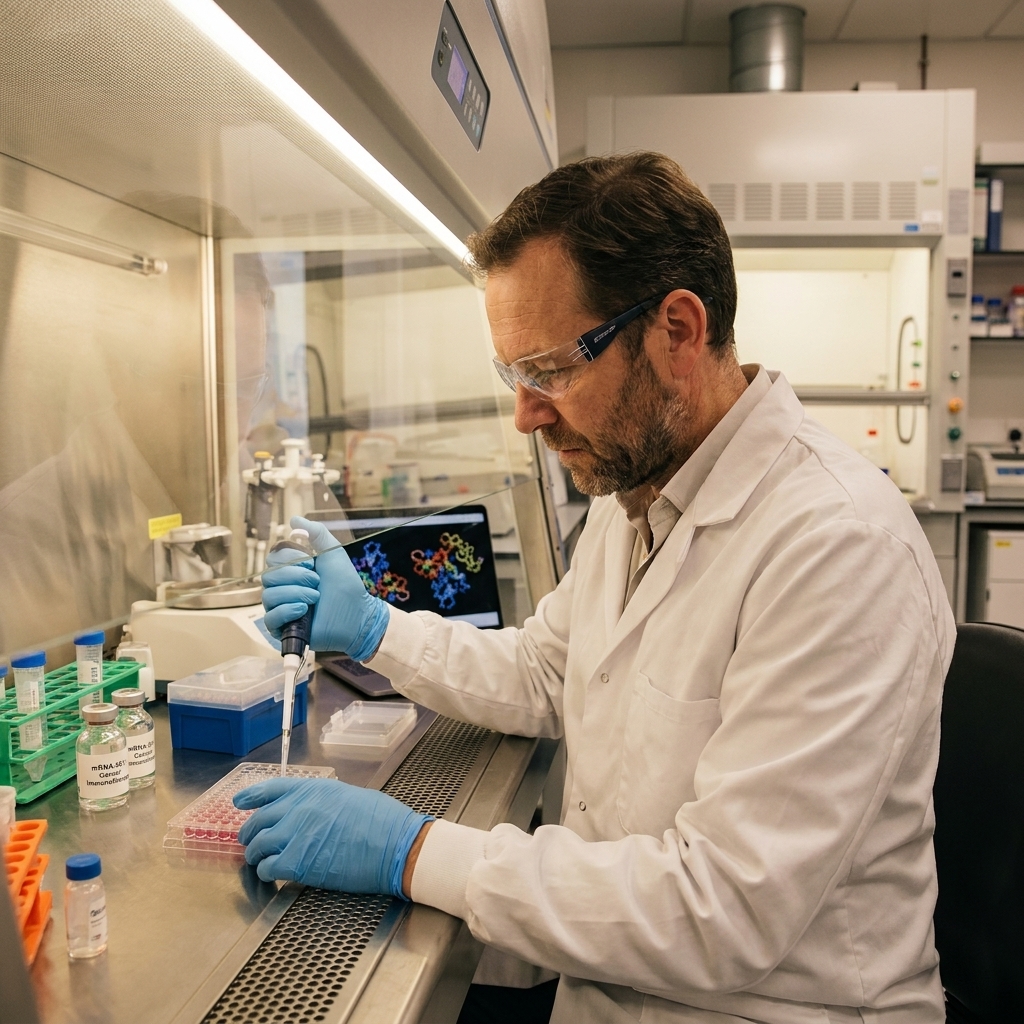
mRNA technology had a very public debut during the pandemic, but the core idea is older, broader, and honestly kind of elegant: instead of delivering a finished protein drug, you deliver the recipe and let your own cells do the cooking for a short time.
If that sounds unsettling, I get it. When I taught high school physics, the fastest way to calm a nervous class before a rocket launch video was to walk through the parts slowly, one by one, until the system felt predictable. mRNA is like that. Once you see how it behaves inside a cell, it becomes less mysterious and more like a well-designed message that fades as cells naturally break it down, after it has been read many times.

mRNA in plain language
mRNA stands for messenger ribonucleic acid. In your cells, it is the disposable copy of genetic instructions. DNA lives in the nucleus like a long-term reference library. mRNA is more like a printout you bring to the kitchen for a short shift. Ribosomes can read it over and over to make many copies of a protein, and then the page gets recycled.
Here is the usual flow in biology:
- DNA stores the long-term instructions.
- mRNA carries a temporary copy of one instruction out to where proteins are made.
- Ribosomes read that mRNA and assemble a protein, one amino acid at a time.
- Proteins do the work: structure, signaling, enzymes, immune defenses, and much more.
So when people say “an mRNA medicine,” what they really mean is: a carefully designed message that asks a cell to make a specific protein for a limited period of time.
What happens inside a cell when mRNA arrives
Step 1: Delivery to the right neighborhood
Naked mRNA is fragile. Your body is full of enzymes called RNases that chop RNA up quickly. That is not a flaw, it is a safety feature. It means RNA messages are naturally temporary.
To protect mRNA long enough to do its job, many modern platforms package it in lipid nanoparticles (LNPs), which are tiny fat-like spheres. Think of an LNP as a padded envelope that helps the message survive the trip and get taken up by cells.
It is also worth noting that LNPs are not the only option. Researchers also explore polymers, peptides, and ex vivo approaches (where cells are treated outside the body and then returned). LNPs are simply the most proven and widely used example so far.
Step 2: Getting the message into the cytoplasm
After injection, LNPs are typically taken up by cells through processes like endocytosis, where the cell wraps membrane around the particle and pulls it inside. The key is then escaping from that internal bubble so the mRNA reaches the cytoplasm, the protein-making floor of the cell. That is where ribosomes are waiting.
Step 3: Translation, the cell’s “recipe reading”
Ribosomes attach to the mRNA and read it in three-letter chunks called codons. Each codon corresponds to an amino acid. The ribosome strings amino acids together into a protein.
Engineers can tune how well this works by designing features such as:
- 5' cap and poly(A) tail: chemical features that help stability and translation efficiency.
- Untranslated regions (UTRs): sequences that influence how long the mRNA lasts and how strongly it is translated.
- Codon optimization: choosing synonymous codons that cells translate more efficiently.
What happens next depends on the protein. Some proteins stay inside the cell to do a job there. Others are routed to the cell surface or secreted. In vaccines and many cancer immunotherapy strategies, proteins (or pieces of them) can be displayed to the immune system through antigen presentation, helping immune cells learn what to recognize.
Step 4: The message fades out
mRNA does not stick around. Cells break it down over hours to days depending on the tissue, dose, and design. Chemistry (including nucleoside modifications), UTR choices, and the delivery formulation can all shift how long a message remains available for translation. This is one of the biggest conceptual differences between mRNA and many gene therapies. The goal is temporary protein production, not permanent genetic change.
Does mRNA change your DNA?
In typical mRNA medicines, the mRNA stays in the cytoplasm and is not designed to enter the nucleus where DNA lives. It also does not carry the machinery needed to integrate into DNA. For integration to be a realistic concern, you would generally need reverse transcription (turning RNA into DNA) plus integration machinery. Standard mRNA therapeutics are not built with those tools.
That said, biology is a big place and there are specialized research areas that intentionally aim for longer-lived effects, including gene editing and certain viral vectors. Those are different toolkits with different risk-benefit profiles and different regulatory scrutiny. Standard mRNA platforms are built around the idea that the message is temporary.
Why lipid nanoparticles matter so much
If mRNA is the software, delivery is the hardware. Many of the breakthroughs in the last decade were not only about designing better mRNA sequences, but also about packaging and delivery that is effective and tolerable.
LNPs typically include a mix of lipids with different jobs:
- Ionizable lipid: helps bind mRNA and assists with endosomal escape, often changing charge depending on pH.
- Phospholipid: supports the particle structure.
- Cholesterol: adds stability.
- PEG-lipid: can influence circulation time and particle behavior.
Delivery also influences where the mRNA ends up. Many LNP formulations naturally accumulate in the liver, which is useful for some therapies and a challenge for others. A big frontier now is tissue-specific delivery, where the same mRNA concept could target immune cells, tumors, or inflamed tissues more precisely.

Beyond vaccines: three big mRNA strategies
Vaccines are one highly successful use case, but mRNA technology is really a platform. Researchers can swap the encoded protein and the delivery method to pursue very different medical goals.
1) Teach the immune system to recognize cancer
Cancer immunotherapy already includes checkpoint inhibitors and CAR-T cells. mRNA offers a complementary idea: train the immune system with tumor-specific targets.
Two common approaches:
- Personalized neoantigen vaccines: a patient’s tumor is sequenced to identify unique mutations. Then an mRNA construct is designed to encode selected neoantigens, aiming to prompt T cells to recognize and attack tumor cells carrying those mutations.
- Shared antigen vaccines: some tumors share common antigens. An off-the-shelf mRNA vaccine can encode these targets, though personalization may improve specificity in certain cancers.
Several personalized cancer vaccine programs are already in clinical testing, often paired with checkpoint inhibitors, because the combination can help newly trained T cells keep doing their job.
What makes cancer a compelling target is urgency and adaptability. Tumors evolve. A platform that can be updated quickly is a practical advantage.
2) Replace or supplement missing proteins
Some diseases involve a missing or dysfunctional protein. Traditional approaches might give the protein directly (which can be difficult if the protein is large, unstable, or needs to be made inside cells). mRNA can instruct cells to produce the protein themselves.
Research areas include:
- Enzyme replacement concepts where making the enzyme inside the right cells could improve function.
- Regenerative signals that transiently produce growth factors to support tissue repair, with careful control to avoid overstimulation.
Many of these programs are still early, but the appeal is straightforward: it is a “borrow the factory” strategy. Instead of shipping the finished product, you temporarily rent the cell’s manufacturing line.
3) Modulate the immune system in autoimmune disease
Autoimmune diseases are the immune system misidentifying the body as the threat. Classic treatments often involve broad immunosuppression. They can work, but they may also raise infection risks because they dampen immune defenses generally.
mRNA opens a more surgical possibility: encourage immune tolerance, or shift immune signaling away from chronic inflammation.
One especially interesting direction uses mRNA to express antigens in a context that nudges the immune system toward tolerance rather than attack. Another focuses on mRNA that encodes proteins that dial down inflammatory pathways. Most tolerance-focused approaches are still preclinical or in early clinical work, but the logic is powerful: if the immune system can be trained into aggression, it might also be trained into peacekeeping.
Cancer vs autoimmune goals
It is tempting to lump everything under “mRNA therapies,” but cancer and autoimmune disease often demand opposite immune outcomes.
- Cancer therapies often aim to activate immune responses, especially T cells that can recognize tumor antigens.
- Autoimmune therapies often aim to reduce harmful immune activity or promote tolerance to self-antigens.
That means delivery, dosing, and even the type of immune signaling triggered by the formulation can be tuned differently depending on the goal.
Safety and side effects
Many people’s lived experience with mRNA is a sore arm, fatigue, fever, or chills after vaccination. Those short-term effects are often signs that the immune system is responding to the signal and the delivery vehicle, not that the mRNA is “doing something permanent.”
You will sometimes hear this called reactogenicity, meaning short-term inflammatory side effects that can follow vaccination or immune stimulation.
For non-vaccine uses, the risk-benefit equation can change. A therapy given repeatedly for a chronic disease has different tolerability demands than a one-time or occasional vaccine. Researchers pay close attention to:
- Innate immune sensing: cells have sensors for foreign RNA. mRNA designs often use modified nucleosides and careful purification to reduce unwanted inflammatory triggers.
- Delivery-related reactions: LNP components can contribute to side effects. Adjusting lipid composition and dosing is a major part of development.
- Off-target distribution: where the mRNA goes matters. Better targeting can improve safety and effectiveness.
As with any medical technology, “safe” is not a single label. It is a profile: what dose, what population, what frequency, and what alternative options exist.
What makes mRNA fast to develop
Once you have a reliable delivery platform, changing the encoded protein is largely a matter of changing the sequence. It is like swapping out an app while keeping the phone.
This speed supports:
- Rapid iteration during early research when teams are testing which protein target works best.
- Personalization in cancer, where each patient’s tumor may call for a tailored set of targets.
- Combination strategies where multiple mRNAs encode different proteins, or mRNA is paired with other therapies like checkpoint inhibitors.
Limits and open problems
mRNA is not magic. It is a very flexible tool with real engineering constraints.
Delivery is still the bottleneck
Getting enough mRNA into the right cells, in the right tissue, without too much spillover is still hard. Many next-generation approaches focus on targeted nanoparticles, cell-specific ligands, and alternative delivery routes.
Durability can be too short
Temporary expression is often an advantage. Sometimes it is not. If a disease requires constant protein production, repeated dosing may be needed, which raises questions about tolerability, practicality, and cost.
Manufacturing and storage
mRNA manufacturing has matured quickly, but scaling and stability are still active areas. Improved formulations that remain stable at more convenient temperatures can widen access globally.
FAQ
Is mRNA the same as gene therapy?
Not usually. mRNA therapies generally deliver temporary instructions that are read in the cytoplasm. Many gene therapies aim for long-lasting changes, often by delivering DNA or editing genes. The goals and mechanisms differ.
How long does mRNA stay in the body?
Typically a short time, often hours to days, depending on formulation and tissue. The protein made from it can persist longer, depending on what it is and how your body processes it.
Could mRNA be used to treat cancer?
That is an active area of research and clinical testing. One promising direction is personalized cancer vaccines that encode tumor neoantigens to help the immune system recognize cancer more effectively, often in combination with other immunotherapies.
Could mRNA help autoimmune disease without suppressing the whole immune system?
That is one of the hopes. Researchers are exploring tolerance-inducing strategies and targeted immune modulation. It is complex work because the immune system is a web, not a single switch.
The takeaway
mRNA technology is best understood as a new way to deliver biological instructions. Vaccines showed the world that the approach can work at scale. The next chapter is about precision: directing mRNA to the right cells, for the right duration, to either rally the immune system against cancer or calm it down when it is attacking the body.
If you want a mental picture to keep: DNA is the cookbook you do not mark up. mRNA is the sticky note recipe you use for a short shift, then throw away. And modern delivery systems are the envelope that makes sure the note arrives in the right kitchen.