The Coriolis effect is one of those science ideas that feels like a magic trick the first time you see it. You set something moving in a straight line, and from the ground it looks like it bends. No invisible force-field required. Just a spinning planet and the fact that different latitudes are moving at different speeds.
If you remember one sentence, make it this: the Coriolis effect is the apparent deflection of moving objects (especially air and water) when you observe them from Earth’s rotating surface. “Apparent” matters. In space, the motion can be perfectly straight. On the rotating Earth, it looks curved.
The basic idea, without math
Imagine you are standing on a merry-go-round, and your friend stands near the edge. You toss a ball to each other. In your friend’s frame, the ball goes straight. In your spinning frame, the ball seems to curve.
Earth works the same way. We live on the rotating platform, so we naturally describe motion using a rotating reference frame. In that frame, straight-line motion often appears to bend.
Two ingredients make the curve show up
- Earth rotates once per day (relative to the stars, about 23 hours 56 minutes).
- Different latitudes have different eastward speeds because they trace different-size circles as Earth turns. The equator is the speed champion. The poles barely move east at all.
So when air or water starts moving north or south, it carries its original eastward motion with it. More precisely, it tends to conserve its angular momentum as it shifts latitude. But the ground beneath it, at its new latitude, is moving east at a different speed. That mismatch is what your brain interprets as a sideways drift when you describe the motion from Earth’s surface.
A rotating-Earth sketch
Here is the simplest mental sketch I teach, the one that helped my students stop treating Coriolis like a spell from a fantasy novel.
Sketch setup: Draw a circle for Earth. Mark the equator as a horizontal line. Now imagine Earth rotating eastward.
- Point A (equator): very fast eastward motion of the ground.
- Point B (higher latitude): slower eastward motion of the ground.
Now the key move: launch an “air parcel” from A toward higher latitude (north in the Northern Hemisphere, south in the Southern Hemisphere). The parcel starts with the equator’s faster eastward motion, and as it moves it largely keeps the extra eastward component it began with (another way to say this is that its angular momentum is conserved). When it reaches B, it is moving east faster than the ground there, so it ends up ahead of where you would expect if you assumed it matched the local surface. From the surface, that looks like a sideways deflection.
Flip the direction, send air from B toward the equator, and it arrives moving east too slowly for the faster-moving ground there. It lags behind, which again looks like a sideways deflection, just the other way relative to its motion.

Why hemispheres differ
This is the part people memorize as a rule, but it actually follows from geometry.
Earth rotates the same direction everywhere, but the way “east” and “north” relate to that spin changes sign across the equator. In a rotating frame like Earth’s surface, the Coriolis deflection ends up perpendicular to motion and depends on hemisphere.
- Northern Hemisphere: motion is deflected to the right of its direction of travel.
- Southern Hemisphere: motion is deflected to the left of its direction of travel.
A teacher-friendly way to say it: if you walk forward, the Coriolis shove is sideways. Which sideways depends on which hemisphere you are standing in. And yes, “right” and “left” are always defined from the traveler’s point of view, looking in the direction of motion.
Also important: it is zero exactly at the equator and increases with latitude, reaching its largest values near the poles. That is because the Coriolis effect scales with sin(latitude). Near 0° latitude, the geometry gives you almost no sideways effect from rotation. Toward the poles, it becomes much easier for rotation to bend your path relative to the surface.
What it does and does not do
It matters most for big motion
The Coriolis effect is tiny for quick, small-scale motion. It becomes important when:
- the motion lasts a long time (hours to days),
- the object travels long distances (hundreds to thousands of kilometers),
- friction is relatively small compared with the motion (common in the free atmosphere and open ocean).
This is why meteorologists care deeply about Coriolis, while your backyard baseball game can safely ignore it. (Long-range artillery and missiles do account for it, because over long times and distances, small deflections add up.)
No, it does not control sinks
The classic myth is that toilets flush opposite directions in opposite hemispheres because of Coriolis. In reality, sinks and toilets are dominated by bowl shape, jet direction, and tiny asymmetries. Coriolis is far too weak at that scale to reliably set the swirl direction.
If you could build a perfectly symmetric, very large tank, keep it still for a long time, and drain it gently, then Coriolis can influence the rotation. But in everyday bathrooms, it is basically a spectator.
Coriolis is not centrifugal
People often blend Coriolis with the centrifugal effect. They are related in the sense that both show up when you describe motion from a rotating frame, but they are not the same. Centrifugal points outward from the axis of rotation, while Coriolis acts sideways to the direction of motion.
Why it matters for winds
On a non-rotating Earth, air would more directly flow from high pressure toward low pressure. In the real atmosphere, friction, convection, and other forces still matter, but rotation adds a major twist: winds often end up flowing around pressure systems rather than straight into them.
Pressure force vs Coriolis
Here is the tug-of-war:
- Pressure-gradient force: pushes air from high pressure toward low pressure.
- Coriolis effect: turns that moving air sideways relative to the rotating Earth.
When those two effects balance (especially higher up where friction is weaker), winds can run roughly parallel to pressure contours. Meteorologists call this geostrophic balance. If “pressure contours” sounds abstract, think of isobars on a weather map, the lines that connect equal pressure. The headline idea is simple: Coriolis helps organize winds into broad, curving flow patterns instead of a straight rush across the map.
Coriolis and storms
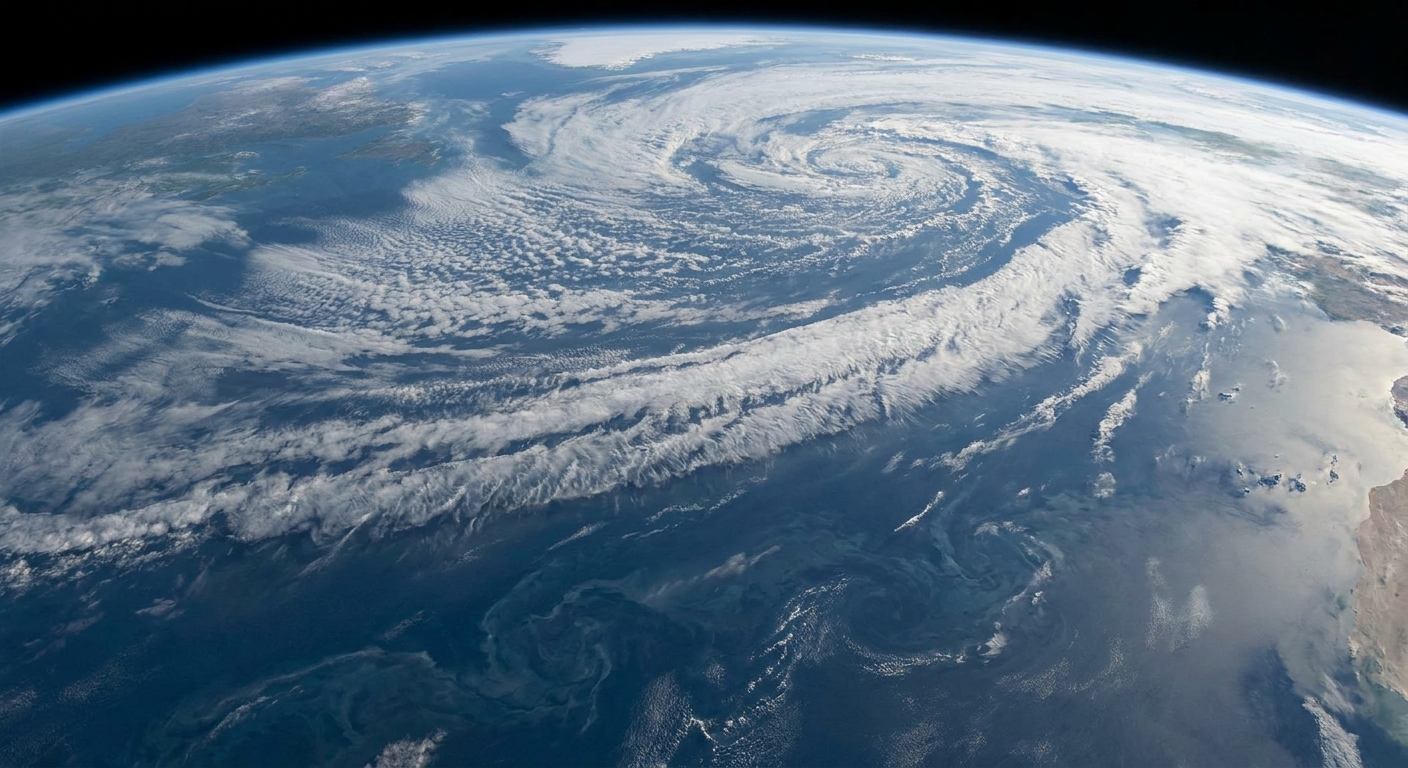
Coriolis is not what starts a storm. Uneven heating, moisture, rising air, and pressure differences do the starting. But once air begins flowing toward a low-pressure center, Coriolis helps turn that inflow into rotation.
Spin by hemisphere
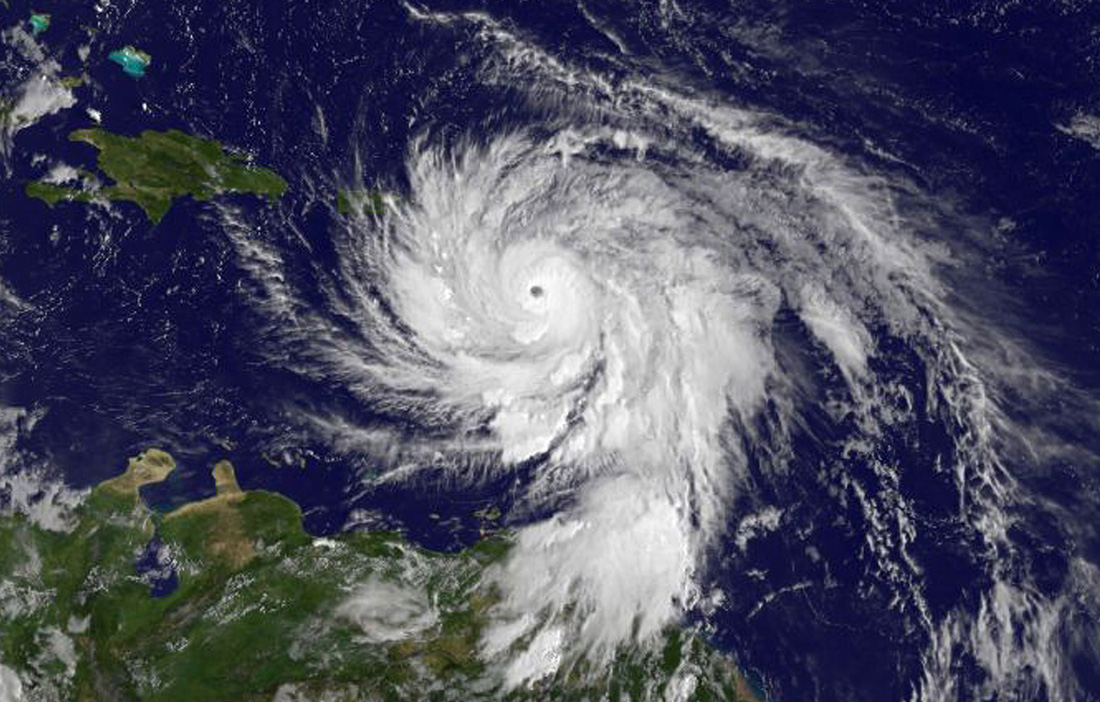
- Northern Hemisphere: large low-pressure systems rotate counterclockwise.
- Southern Hemisphere: large low-pressure systems rotate clockwise.
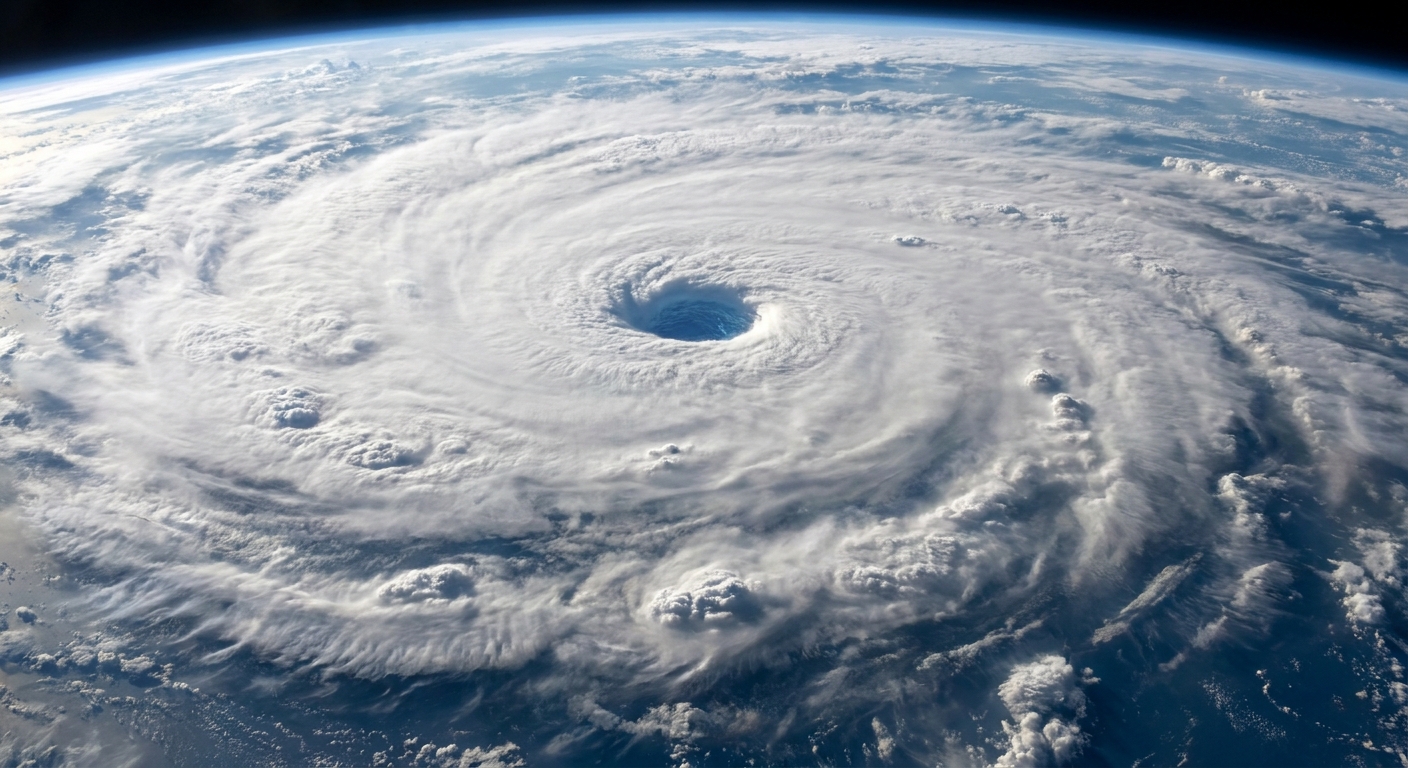
That familiar hurricane spiral you see on satellite images is basically a marriage between pressure-driven inflow and Coriolis turning. Near the surface, friction weakens the turning and allows air to cross isobars and spiral inward, feeding the storm, rather than circling perfectly around it.
One more subtle point: tropical cyclones struggle to form very close to the equator because Coriolis is weak there. That is one reason you rarely see hurricanes born within a few degrees of latitude of the equator.
For completeness: high-pressure systems (anticyclones) generally rotate the opposite way, clockwise in the Northern Hemisphere and counterclockwise in the Southern Hemisphere.
Ocean currents
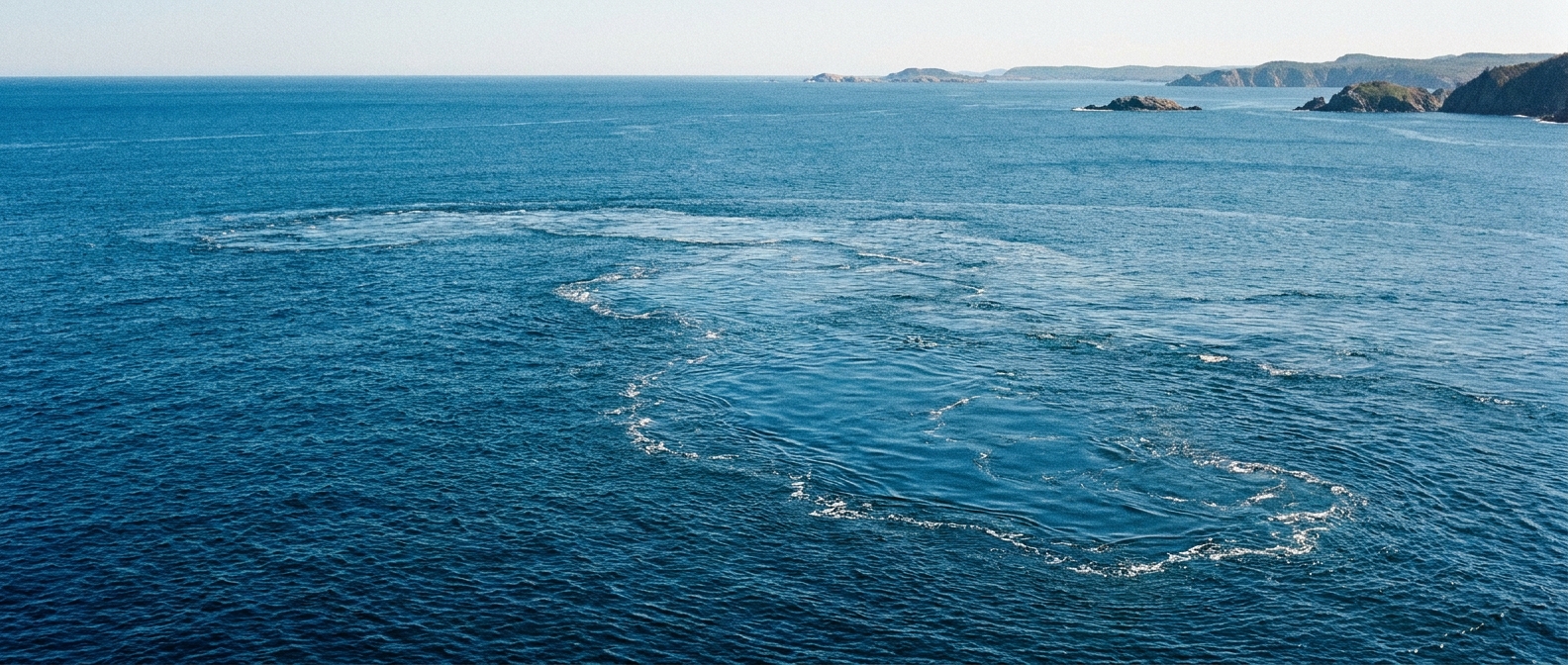
Water feels Coriolis too. Ocean currents often curve and organize into large rotating systems called gyres.
Wind pushes the ocean surface, but Coriolis turns that motion. With depth, friction between layers and Coriolis create a beautiful twist called the Ekman spiral (each layer moves a bit more sideways than the layer above). The net effect is that surface wind does not push water exactly downwind, and the ocean ends up piling water in some regions and drawing it down in others. That sets up pressure differences in the ocean that help maintain large-scale currents.
Quick FAQ
Is the Coriolis effect a real force?
In an Earth-fixed rotating frame, we treat it like a force because it predicts motion correctly. In an inertial frame (like space), it is not needed. It is a consequence of describing motion from a rotating viewpoint.
Does Coriolis change speed or just direction?
In the idealized physics, Coriolis acts perpendicular to motion, so it mainly changes direction, not speed. Real winds and currents also speed up or slow down because of pressure forces and friction.
Why do planes not constantly drift off course?
They would if pilots did nothing. But navigation accounts for winds, and winds themselves are shaped by Coriolis. Also, airplanes are actively controlled and constantly corrected.
What is the simplest rule to remember?
Right in the Northern Hemisphere, left in the Southern Hemisphere, zero exactly at the equator, increasing toward the poles, and most important for large-scale, long-duration flows.
The takeaway
The Coriolis effect is what you get when straight-line motion meets a rotating planet. Because Earth spins and because different latitudes move east at different speeds, moving air and water appear to curve relative to the surface. That curve flips between hemispheres, and it becomes a big deal for the atmosphere and ocean, shaping everything from broad wind belts to the spin of cyclones.
Once you see Earth as a giant, slow merry-go-round, the Coriolis effect stops being mysterious and starts being inevitable.