I used to tell my physics students that if Earth had a central heating system, the ocean would be the boiler room. The Atlantic Meridional Overturning Circulation, usually shortened to AMOC, is one of the biggest pieces of that plumbing. It helps move heat, salt, oxygen, and nutrients around the Atlantic Ocean, and it is one reason the North Atlantic and nearby land areas are warmer than they would otherwise be.
One important nuance, though: Europe’s mild climate is not powered by ocean currents alone. Prevailing westerly winds and atmospheric heat transport do a lot of the day-to-day heavy lifting, while AMOC is an important contributor to North Atlantic heat content and the temperature gradients that the atmosphere responds to.
But AMOC is not a single current you can point at like a river. It is a whole-basin circulation pattern that includes surface currents, deep currents, and the slow process of water masses sinking and spreading through the ocean’s interior.
The AMOC in one sentence
Warm, salty surface water flows northward, releases heat to the atmosphere, becomes denser, sinks in key North Atlantic regions, and returns southward as cold deep water.
If you like analogies: think of a two-lane highway. One lane, at the surface, carries warm water north. The other lane, deep down, carries colder water back south. The “on-ramps” and “off-ramps” are places where water changes density enough to sink or rise.
What it is and is not
Bigger than the Gulf Stream
The Gulf Stream is a fast, narrow surface current along the U.S. East Coast that later becomes part of the broader North Atlantic Current system. AMOC includes that surface flow and the deep return flow. So when people say “the Gulf Stream is shutting down,” they are often really talking about AMOC weakening, which is not the same claim.
It also helps to remember that the Gulf Stream near the coast is strongly shaped by winds and the broader Atlantic circulation. It is connected to overturning, but it is not a simple one-to-one AMOC speedometer.
Not a switch
AMOC varies naturally from year to year and decade to decade. It is influenced by winds, temperature patterns, salinity changes, and large-scale climate cycles. Because it involves the deep ocean, many parts of it change on slower timescales than day-to-day weather.
Climate, not a forecast
AMOC affects how heat is distributed across the Atlantic and how the atmosphere responds on average. That matters for seasonal patterns and long-term climate trends, but it does not tell you whether a specific winter will have a particular snowstorm in Paris.
How overturning works
The key word is density. Seawater gets denser when it is colder and when it is saltier. AMOC’s overturning depends on the delicate balancing act of temperature and salinity.
- Step 1: Northward surface flow. Warm, salty water moves north in the upper ocean, partly driven by winds and partly by pressure gradients associated with density contrasts.
- Step 2: Heat release to the air. In the North Atlantic, especially in winter, the ocean gives up a lot of heat to the atmosphere. That heat can then influence storms and prevailing winds.
- Step 3: Water becomes dense and sinks. Cooling increases density, and in some regions the surface water can sink to form deep water masses. This sinking is sometimes called deep convection. Key areas include the Labrador Sea and Irminger Sea, while the Nordic Seas contribute through dense overflows that spill across sills between Greenland, Iceland, and Scotland.
- Step 4: Southward deep return. The newly formed cold, dense water spreads southward at depth, completing the large-scale overturning loop.
It is slow compared to the currents you can see in satellite animations. Within the Atlantic, some deep pathways take decades, and the deeper, longer-distance renewal times can extend to centuries. Those pathways are shaped by seafloor topography like ridges and basins.
Why weakening matters
To weaken AMOC, you generally need to make it harder for surface water in the North Atlantic to become dense enough to sink. The two big levers are warming (less cooling, lower density) and freshening (less salinity, lower density).
Freshwater can enter the North Atlantic from increased rainfall, river discharge, and melting land ice such as the Greenland Ice Sheet. Freshwater is lighter than salty seawater, so adding it can act like a buoyant “lid” that discourages sinking in key regions.
In climate models, greenhouse-gas-driven warming tends to reduce the density contrast that helps drive deep water formation, making AMOC more likely to weaken over the long term. Exactly how much, and how fast, is an active research question.
And because this comes up in headlines: scientists also discuss the risk of abrupt change. Many major assessments describe a full AMOC collapse this century as low probability, but not impossible, with uncertainty tied to emissions, freshwater input, and how the system responds to continued warming.
What a weaker AMOC could change
European winters
AMOC helps deliver heat to the North Atlantic. If less heat is transported northward, the pattern of sea surface temperatures can shift, which can nudge atmospheric circulation. That can influence:
- Winter temperature patterns across parts of Europe and the North Atlantic region
- Storm tracks and where storms tend to intensify
- Marine heat distribution that affects coastal climates on both sides of the Atlantic
One common misconception is that a weaker AMOC automatically means Europe plunges into an ice age. Reality is subtler: Europe is also warming due to greenhouse gases. A weakened AMOC could reduce some of the warming influence from ocean heat transport, especially in the North Atlantic region, and it could change where winter cold snaps and storms are most likely, but it does not simply “cancel out” global warming.
Sea level on the U.S. East Coast
AMOC affects sea level because currents and density structure influence how water is “piled up” by ocean circulation. A weaker AMOC can contribute to higher relative sea level along parts of the U.S. East Coast, on top of sea level rise from warming oceans and melting ice.
The size of that circulation-driven sea level effect can be regional and episodic, and it can interact with winds, the Gulf Stream’s position, and coastal ocean dynamics. It is not the only sea level story, but it is one piece that matters for Atlantic coast risk.
Ecosystems and oxygen
Because AMOC helps ventilate the deep ocean, changes can affect:
- How oxygen reaches deeper layers
- Nutrient pathways that support food webs
- Where fish and plankton thrive as temperature patterns shift
How it is monitored
You cannot measure AMOC by dropping a single instrument in the water. It is too wide and too deep. Instead, oceanographers combine multiple observing systems, each capturing a different part of the story.
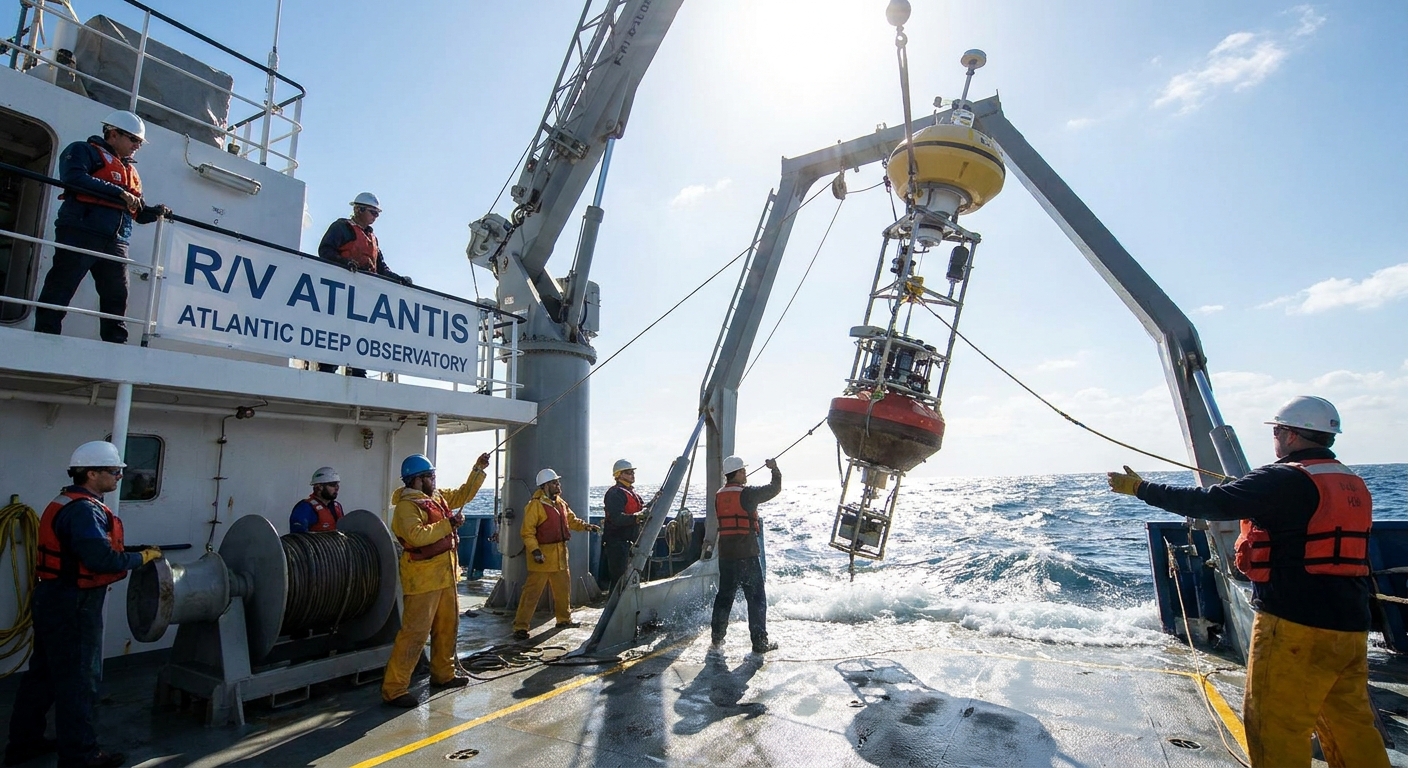
Mooring arrays
One of the most direct ways to estimate AMOC strength is to deploy arrays of moorings across an ocean basin. Two well-known examples are RAPID-MOCHA (near 26.5°N) and OSNAP (in the subpolar North Atlantic). These are anchored lines with instruments at various depths that measure:
- Temperature and salinity (to infer density)
- Pressure differences across the basin
- Current velocities at different depths
From these measurements, scientists can reconstruct the northward and southward flows and estimate how much water is overturning.
Argo floats
Argo floats drift with ocean currents, periodically diving to depth and resurfacing to transmit profiles of temperature and salinity. They do not measure AMOC directly across the entire basin, but they provide crucial context: how heat and freshwater are changing in the upper and mid-depth ocean.
Satellites
Satellites measure sea surface height, sea surface temperature, winds, and gravity-related changes in ocean mass distribution. These are not a direct AMOC meter, but they help constrain models and reveal changes in surface patterns that often travel with circulation shifts.
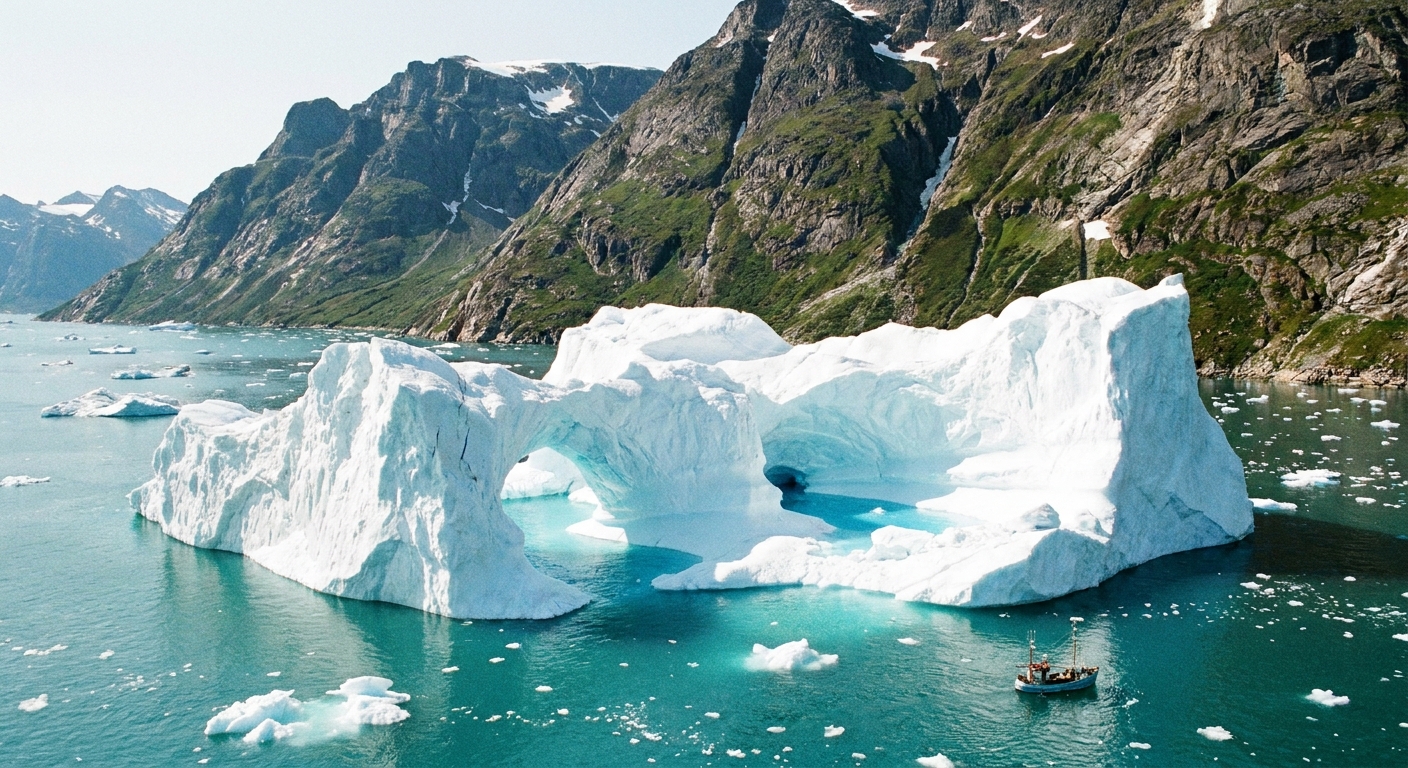
Ship surveys
Research vessels still matter. Full-depth measurements of temperature, salinity, dissolved oxygen, and tracers allow scientists to track the fingerprints of deep water masses and see long-term changes that moorings might miss if they are concentrated in one latitude band.
AMOC and the conveyor belt
You may have heard AMOC described as part of the global conveyor belt, also known as the thermohaline circulation. That phrase tries to capture the idea that temperature and salinity differences help drive a planet-spanning pattern of connected currents across multiple ocean basins.
AMOC is the Atlantic’s starring role in that larger play. The Atlantic is unusual because it transports a lot of heat northward compared to other basins, and because its deep water formation is a major engine for global deep ocean circulation.
FAQ
Is AMOC the same as the Gulf Stream?
No. The Gulf Stream is a surface current. AMOC includes the surface flow and the deep return flow, plus the sinking and spreading of dense water that makes it an overturning circulation.
Is AMOC slowing down right now?
Measurements show AMOC varies a lot from year to year, and the direct observing record is relatively short compared with the timescales of deep ocean change. (For example, continuous basin-scale arrays like RAPID have been operating since the mid-2000s.) Multiple lines of evidence, including climate models and some observational reconstructions, suggest a long-term weakening is plausible under continued warming, but pinning down the exact trend and its causes is an active area of research.
Would a weaker AMOC make Europe colder?
It could reduce northward ocean heat transport and shift North Atlantic temperature patterns, which can influence European winter conditions. But Europe is also warming due to greenhouse gases, so the likely outcome is not a simple “Europe freezes” storyline. Expect changes in regional patterns, not a universal rewind to the Little Ice Age.
What might show up first if AMOC weakened?
You would not feel AMOC directly like a gust of wind. Some of the earliest expected signals in observations include shifts in North Atlantic sea surface temperature patterns, regional storminess, and changes in coastal sea level along the Atlantic margins.
The takeaway
AMOC is the Atlantic’s giant heat-moving loop: warm water heads north at the surface, cold water returns south in the deep ocean. Because it redistributes heat, a weaker AMOC would not just be an ocean story. It would be a climate story, with real consequences for European winters, Atlantic heat distribution, ecosystems, and coastal sea level.
And the good news for curious humans like us is that this is not a mystery unfolding unseen. Scientists are watching, day after day, with moored arrays, roaming floats, satellites, and old-fashioned ship time. The Atlantic may be vast, but it is not unmeasured.