
If you have played Minecraft long enough, you know the feeling: the Overworld is home, the Nether is danger, and the End is a boss room wearing a dimension’s clothing. Now imagine opening a door that is not just a new coat of paint, but a whole new ruleset. That is what the Sift represents: a major new vanilla dimension built around soul mechanics.
The Sift is not just a place to sightsee. It is an environmental puzzle you survive, solve, and eventually harness.
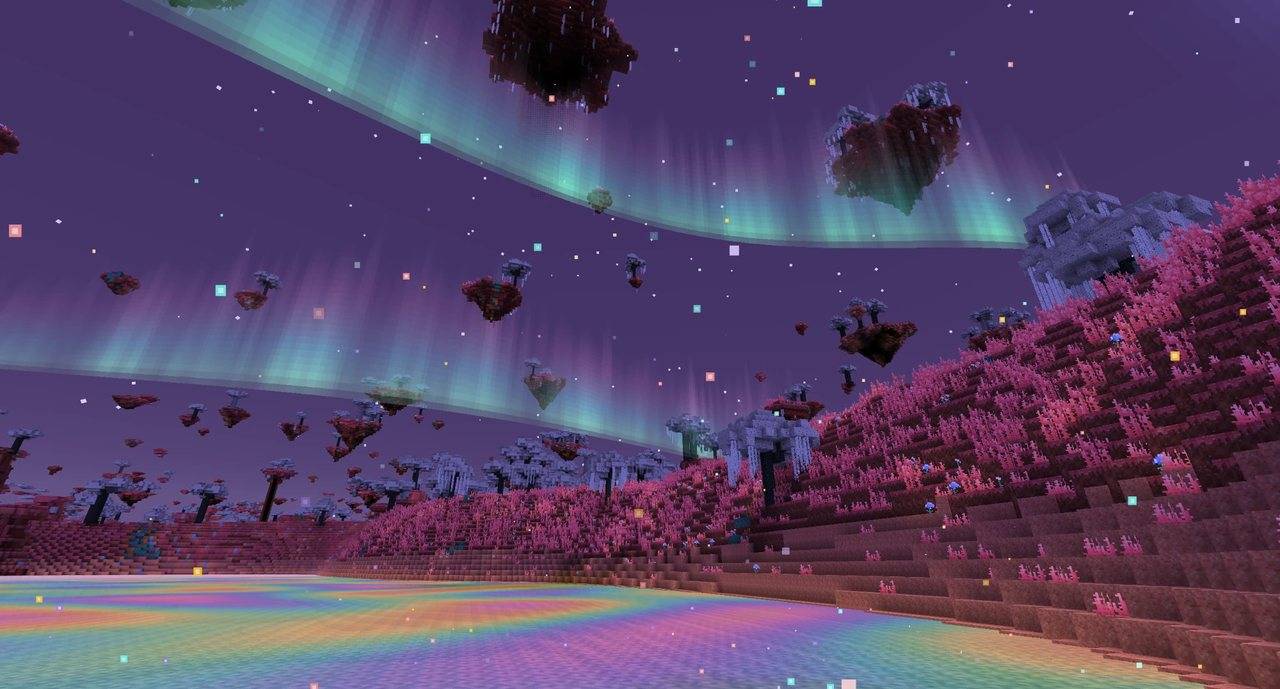
Deep Dark to bright sky
The Sift’s portal resides in the Deep Dark, which makes its reveal feel like stepping through a trapdoor and landing in daylight. On the other side, the sky flips the mood completely: a bright turquoise canopy with a colorful aurora overhead. It is the kind of contrast Minecraft does well when it wants to make you feel like you have truly left your world behind.
Three biomes, three problems
The Sift’s terrain reads like three chapters of the same science book, each one asking a different question about how this place works.
The Meadows
This is the Sift at its most inviting. The ground is covered in bright pink grass, and the plant life is distinct enough that you instantly know you are not in any Overworld analog. You will run into willow trees and specialized plants called “Tuner” flowers, which hint that sound and resonance matter here.
The Carapace (or Carropus)
Swap the softness for something ancient and exposed. The Carapace is a desert-like biome dominated by colossal bone structures and fossils. It feels like exploring the ribcage of a world, a place built from remains rather than soil.
Lullababy Hills
This area is the most overtly unnatural: barren, gravity-defying, and threaded with floating stone walkways. If the Meadows is biology and the Carapace is geology, Lullababy Hills is pure physics. The terrain itself dares you to trust your footing.
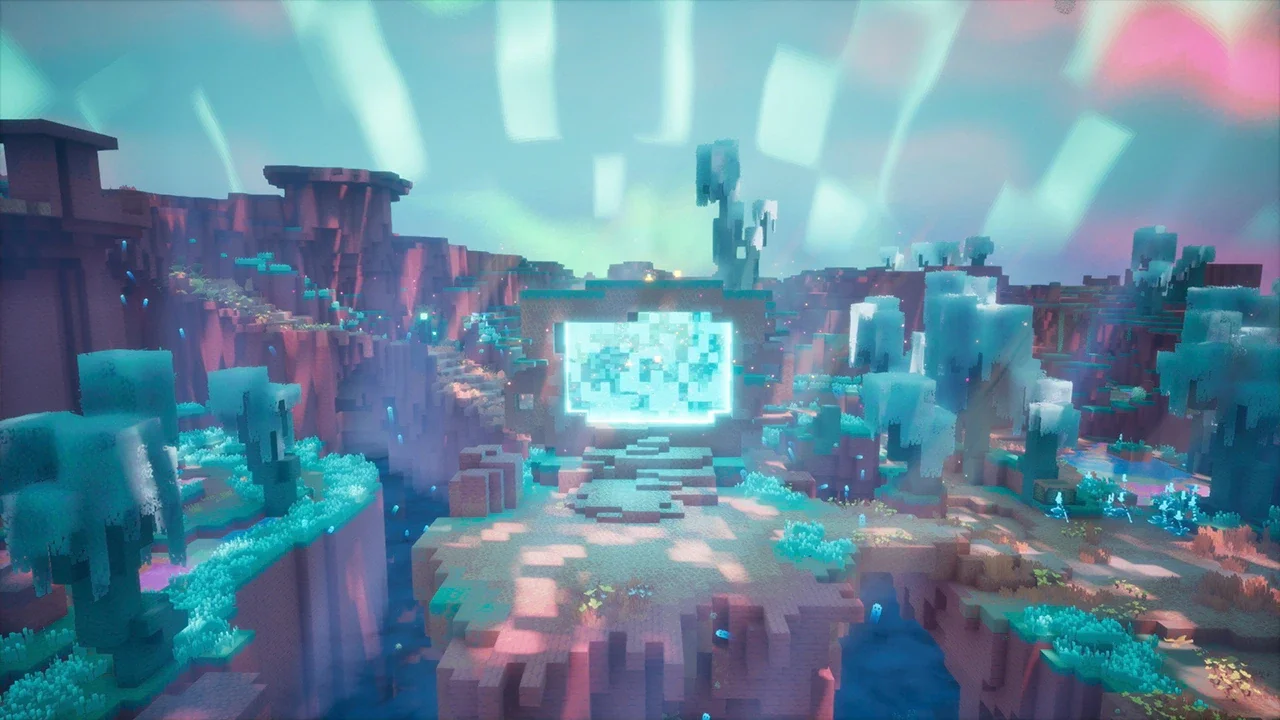
Sift Tides
Minecraft’s day-night cycle usually works like a timer. In the Sift, it behaves more like a switch that changes what reality allows. The dimension runs on its own cycle called Sift Tides, with two distinct states.
Flow and Thrive
During the day phase, the Sift “turns on” in a very specific way. A passive entity called The Singer becomes active, and the landscape enters a period of soul regeneration that gives life to passive creatures. In practical terms, daytime is when the Sift feels like it is breathing.
Endure
At night, the rules harden. Soul generation stops completely, and the dimension pushes back. The environment becomes highly hostile, spawning tougher mobs and forcing players to weather aggressive encounters. If daytime is a recovery window, nighttime is a stress test.
From a systems standpoint, this design makes exploration, base-building, and resource runs feel like planning around tides rather than simply sleeping through danger.
Mobs and materials
The Sift brings new toys, but they are not just loot. They are tools that plug into the dimension’s soul-first logic.
Echo Golems and Pure Soul Blocks
Echo Golems act as peaceful caretakers. The detail that matters is what they carry: Pure Soul Blocks balanced on their heads. Players can deactivate or activate these golems by manipulating those blocks, and the blocks can also be harvested. Their use is not cosmetic. Pure Soul Blocks can power new forms of infrastructure like machinery, gates, or bridges, turning the Sift into a place where engineering is part of progression.
Ichor
Ichor is a glowing liquid resource found flowing through the dimension. Under some gameplay states, it functions like a healing pool, which is exactly the kind of thing you want in a dimension that can suddenly shut off soul regeneration at night. But the Sift does not hand out freebies. Corrupted ichor punishes careless movement: step on it and it can drain health and even your soul meter.
Siftite
Then there is Siftite, a rare tier material found in the Sift. It is rumored to allow players to upgrade their gear beyond Netherite standards. Even without overhyping it, that rumor alone changes how players think about risk. A higher ceiling is a powerful motivator to learn a dimension’s quirks instead of visiting once and leaving.

Building a new dimension
It is easy to talk about biomes and mobs. The more invisible story is what it takes to make a brand-new dimension behave like a first-class citizen in Minecraft’s engine, especially in a game that also needs to keep old worlds functional.
File identity
Internally, the Sift is coded under the development codename Wellspring. More importantly, it is not treated like a reskinned area. Adding it requires a new entry in the dimension registry, giving it its own dedicated folder structure alongside dim0 (Overworld), dim-1 (Nether), and dim1 (End).
Redstone and sound
Unlike the simple logic of obsidian frames or End portals, Sift access depends on specific game-state conditions driven by redstone and sound. The ancient city portal is triggered through data-driven acoustics, where the engine scans for specific note block frequencies paired with a goat horn sound clip.
Once the trigger conditions are satisfied, the portal’s block entities perform dynamic state transformations, including cleaning out sculk veins and swapping proximity block textures to open the gateway.
Server impact
If you run a server, a fourth dimension is not a minor patch. It means handling new regional chunk generation in an additional asynchronous region folder, with extra RAM overhead to track player activity across four active dimensions instead of three.
There is also the challenge of rolling this into existing worlds. Updates aim to adapt older saves, but because the Deep Dark’s ancient structures are overhauled to support the portal, server owners may need to clear unrendered border chunks or use external chunk-pruning tools so the new portal scripts can generate as intended.
Java and Bedrock parity
The Sift needs to launch simultaneously across Java Edition (C++) and Bedrock Edition (RenderDragon engine), which pushes development toward standardized, data-driven systems. Features like the turquoise aurora sky rendering and the local soul meter mechanics are built with newer JSON component structures to keep behavior and performance aligned, whether you are on a high-end PC or a phone.
Why it stands out
The Sift is doing something that is deceptively hard to pull off: it makes the environment behave like a system you must understand. The Sift Tides make time meaningful, soul dynamics make the landscape feel alive, and the new blocks and entities turn exploration into engineering.
If the Sift lands the way it is designed, it will not just give players more space. It will give them new rules to think with. And that is the kind of update that creates those classic Minecraft “aha!” moments all over again.