There is a tiny magic trick happening every time you put on active noise-canceling (ANC) headphones and the airplane cabin seems to exhale into quiet. The trick is not foam, not willpower, and not your brain “tuning things out.” It is physics: your headphones are listening to the world, modeling what the next split second of noise will look like, and then playing a carefully shaped counter-sound to reduce it.
As a former classroom physics teacher, I love ANC because it turns a big, abstract idea into something you can feel instantly: destructive interference . Sound plus sound can equal less sound, if you line it up just right.
Sound waves: the invisible wiggle
Sound is a traveling vibration. When a speaker cone moves outward, it compresses nearby air molecules. When it moves inward, it creates a rarefaction, a region of lower pressure. Those compressions and rarefactions propagate as a wave through the air until they reach your eardrum, which vibrates right along with them.
Two wave details matter a lot for noise cancellation:
- Frequency (measured in hertz, Hz): how many wave cycles pass per second. Low frequencies are bassy rumbles, like engines and HVAC. High frequencies are hissy or sharp, like clinking dishes or consonants in speech.
- Amplitude: how strong the pressure variation is. Bigger amplitude generally means louder sound.
If you could freeze a moment of sound in space, you would see a pattern of higher and lower pressure regions. ANC is basically trying to create a second pattern that “un-wiggles” the first one at your ear.

The core idea: destructive interference
When two sound waves meet, the air pressures add together. This is called superposition. If both waves are compressions at the same time, they reinforce and the sound gets louder. If one is a compression while the other is a rarefaction of equal size at your eardrum, they can largely cancel at that point.
That cancellation is destructive interference. The classic textbook version is two identical waves shifted by half a cycle, also described as a 180-degree phase difference. Where one wave says “push,” the other says “pull.” The result can be dramatically quieter.
ANC headphones aim to do this at the point that matters: near your eardrum. They measure the incoming noise, generate an “anti-noise” wave, and play it through the headphone speaker so the two waves interfere destructively inside the ear cup or ear canal.
Active noise cancellation is not silence. It is a controlled tug-of-war between two pressure waves, timed so the net pressure variation at your ear is smaller.
Passive vs active: two shields
Before we get more “active,” it helps to separate two kinds of noise reduction that often get lumped together:
Passive isolation
This is the physical blocking of sound. Thick ear pads, a good seal, and in-ear tips all reduce how much outside sound reaches your ear in the first place. Passive isolation tends to be especially helpful at higher frequencies, because shorter-wavelength sounds are easier to obstruct with materials and airtight seals. It also matters for low frequencies because a leaky seal gives bassy noise an easy path in, especially with earbuds.
Active noise cancellation
This is the wave-canceling trick. ANC is usually strongest at lower frequencies, where the noise is more steady and easier for the system to model, like engine hum, bus rumble, or fan noise.
Most good headphones combine both: passive isolation takes a bite out of the highs (and helps everything else), and ANC goes after the lows.
What’s inside ANC headphones
Modern ANC is a tight coordination between hardware and signal processing. Here are the main actors:
- Microphones that pick up ambient sound.
- A processor (often a dedicated DSP, digital signal processor) that computes the anti-noise.
- Speakers that play both your music and the anti-noise signal.
- Adaptive control that updates the filtering continuously to stay stable and tuned for different fits and environments.
- Power from a battery, because analyzing and generating sound in real time costs energy.
Feedforward, feedback, and hybrid ANC
Headphone companies use a few microphone strategies. The names sound fancy, but the basic idea is simply where the headphones “listen” from.
Feedforward ANC
A microphone on the outside of the ear cup samples the environment. The processor estimates how that noise will arrive at your ear a moment later and generates anti-noise.
Pros: Can react early, before the noise leaks in.
Tradeoffs: If wind hits the mic or the noise changes rapidly, estimation gets harder.
Feedback ANC
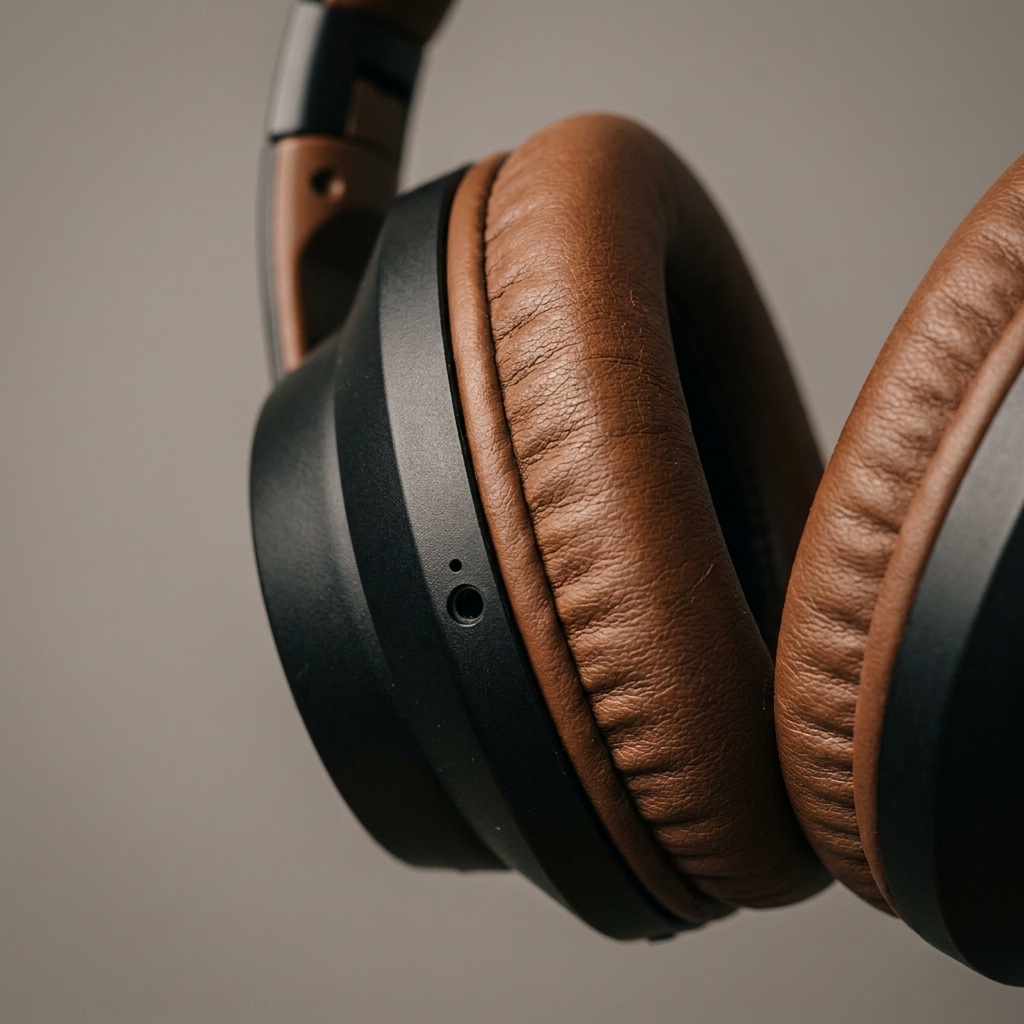
A microphone inside the ear cup measures the sound that actually made it in, including how the ear pad seal and your ear shape affect things. The system then corrects what you are hearing in near real time.
Pros: Automatically accounts for fit and seal differences.
Tradeoffs: It is “later to the party” since the noise has already entered the cup.
Hybrid ANC
Many premium headphones use both outside and inside microphones. Feedforward helps with anticipation, feedback helps with cleanup. Think of it like having a weather forecast plus a thermometer.
Timing: why sudden noise is hard
To cancel a wave, you need to match its shape and line it up in time. That means your headphones must:
- Detect the noise
- Compute the anti-noise
- Play it through the driver
- Have it reach your eardrum
All of that takes a tiny but crucial amount of time, called latency. If the anti-noise arrives late, the phase match is off and cancellation weakens. This is one reason ANC is famously good at steady, low-frequency noise (which changes slowly) and less miraculous for sharp, high-frequency transients like keyboard clicks, clattering dishes, or a sudden shout.
There is also a wavelength issue. Low-frequency sound has a long wavelength, so small timing errors still leave the wave close enough to opposite-phase for decent cancellation. High-frequency sound has short wavelengths, so the same timing error can shift you from perfectly opposite to not even close.
Fit matters
ANC is not happening in an empty room. It is happening in a small, messy acoustic space: the ear cup cavity or the ear canal. The seal around your ear changes how sound leaks in and how pressure variations behave inside.
That is why:
- Glasses can reduce cancellation by creating a tiny gap under the ear pad.
- Hair or earrings can matter for over-ear models, again by affecting the seal.
- Ear tip size is everything for in-ear ANC, because a poor seal lets low-frequency noise sneak in and also changes the “acoustic load” the speaker is working against.
Feedback and hybrid systems help compensate, but they cannot break the laws of acoustics. A good seal is still the easiest “free upgrade.”

The “pressure” feeling
Some people report a sensation of ear pressure or “cabin-like” fullness with ANC, even when the headphones are not physically squeezing. There are a few likely contributors:
- Reduced low-frequency fluctuations: Your brain is used to a certain baseline of low-frequency environmental noise. When that rumble vanishes, the contrast can feel strange.
- Perceptual effects: ANC changes the low-frequency sound field in the sealed volume, and your auditory system can interpret that shift as a pressure-like sensation.
- Fit and sealing effects: A very tight seal can make low-frequency changes more noticeable, which can amplify the “full” sensation.
It is not that ANC is pumping static pressure into your ear like a syringe. It is reshaping pressure variations over time, and your brain is a surprisingly opinionated interpreter.
Limits of ANC
Marketing can make ANC sound like an on-off switch for the universe. In reality, it is more like turning down certain parts of the world.
It struggles with
- High-frequency, irregular noise (clinks, clicks, sudden squeaks)
- Wind noise (turbulent airflow across microphones can overwhelm the signal)
- Voices nearby (speech has rapid changes and lots of higher-frequency content that leaks around seals)
It shines with
- Engines and motors
- Airplane cabin rumble
- Train and bus noise
- Fans and HVAC
Many headphones now offer modes like “adaptive ANC” or “transparency.” Those features rely on the same microphone and DSP pipeline, but they either vary how strongly anti-noise is applied or intentionally pipe outside sound in so you can hear announcements and conversations.
Audio quality and safety
Because ANC is constantly adding an anti-noise signal, it can sometimes slightly change the sound of your music, especially in the bass or lower mids. Transparency mode can also sound a bit “processed” because you are hearing the world through microphones, not directly.
One practical note: full ANC is wonderful on planes and in offices, but it is not always a great idea when you need situational awareness. If you are walking near traffic, cycling, or waiting for an announcement, transparency mode (or simply lowering ANC strength) is the safer choice.
Try this at home
If you want to feel the physics without any special equipment, try this:
- Put on ANC headphones with no music.
- Stand near a steady sound source, like a bathroom fan, range hood, or air purifier.
- Toggle ANC on and off.
Notice what changes most. For many people, the fan’s low rumble drops dramatically, while higher-pitched components change less. That is destructive interference working where it has the easiest job: slow, predictable pressure waves.
FAQ
Do noise-canceling headphones block sound or erase it?
Both, depending on what you mean. The ear pads or ear tips block some sound passively. ANC then reduces remaining sound by generating an anti-noise wave that causes destructive interference near your ear.
Is ANC bad for your ears?
ANC itself does not inherently damage hearing. Hearing risk mostly depends on volume and exposure time. In fact, some people find ANC lets them listen at lower volumes in loud environments. If you experience discomfort or headaches, try reducing ANC strength (if your model allows it), improving fit, or taking breaks.
Why do my headphones hiss when ANC is on?
A faint hiss can come from the electronics noise floor, microphone self-noise, or the DSP boosting certain frequencies as it tries to cancel others. It is often most noticeable in quiet rooms because there is less ambient sound to mask it.
Why is ANC weaker when I smile or chew?
Because the seal changes. Over-ear pads can shift slightly with jaw movement, and in-ear tips can change position in the ear canal. Small geometry changes alter how sound leaks and how waves reflect inside the cavity, which affects cancellation.
The takeaway
Active noise cancellation is one of my favorite examples of physics you can wear. Your headphones are constantly measuring pressure waves, computing an equal-and-opposite response, and pushing air in just the right rhythm so that, at your eardrum, the world’s wiggles largely subtract instead of add.
It is not perfect, and it cannot bend reality. But for the low, steady growl of modern life, it is a wonderfully practical triumph of wave physics, microelectronics, and a little bit of real-time math.