What pH Means
pH is a way to express how acidic or basic a solution is. In rigorous chemistry, pH is defined using hydrogen ion activity (aH+). In most introductory problems, activity is approximated by concentration, so you will often see pH tied to [H+].
- pH = -log10[H+]
- pOH = -log10[OH-]
- At 25°C in pure water: [H+][OH-] = Kw = 1.0 × 10⁻¹⁴
- At 25°C: pH + pOH = 14.00
Acids and Bases in Plain Terms
There are a few common definitions you will see in chemistry:
- Arrhenius: acids produce H+ in water; bases produce OH- in water.
- Brønsted-Lowry: acids donate a proton (H+); bases accept a proton.
Strong vs. Weak
This matters because it changes how you calculate pH.
- Strong acids/bases dissociate essentially completely in water (in typical intro problems). Examples: HCl, HNO3, HBr; NaOH, KOH.
- Weak acids/bases dissociate only partially and require an equilibrium approach. Examples: acetic acid (CH3COOH), ammonia (NH3).
How to Calculate pH
Most pH problems fall into a few patterns: strong acids/bases, weak acids/bases (equilibrium), dilution, and neutralization (mixing acid and base). Below are the ones you are most likely to see, with worked examples.
1) Strong acid
Example: Find the pH of 0.010 M HCl (at 25°C).
- HCl is a strong acid, so [H+] ≈ 0.010 M.
- pH = -log(0.010) = 2.00.
Note: For extremely dilute strong acids (near 10-7 M), water autoionization can matter. In typical classroom concentrations, the approximation above is expected.
2) Strong base
Example: Find the pH of 0.0020 M NaOH (at 25°C).
- NaOH is a strong base, so [OH-] ≈ 0.0020 M.
- pOH = -log(0.0020) = -log(2.0 × 10⁻³) = -(0.301 - 3) = 2.699 ≈ 2.70.
- pH = 14.00 - 2.70 = 11.30.
3) Weak acid (using Ka)
Example: Find the pH of 0.10 M acetic acid, CH3COOH. Use Ka = 1.8 × 10⁻⁵ (at 25°C).
Set up the equilibrium: CH3COOH ⇌ H+ + CH3COO-
ICE (in M):
- Initial: 0.10, 0, 0
- Change: -x, +x, +x
- Equilibrium: 0.10 - x, x, x
Ka = x2/(0.10 - x) = 1.8 × 10⁻⁵
Here, x represents [H+] produced by the acid. For a weak acid, x is usually small compared with 0.10, so 0.10 - x ≈ 0.10:
- x ≈ √(Ka × C) = √(1.8 × 10-5 × 0.10) = √(1.8 × 10⁻⁶) ≈ 1.34 × 10⁻³ M
- So [H+] ≈ 1.34 × 10⁻³ M and pH = -log(1.34 × 10⁻³) ≈ 2.87
Check the approximation: x/C = (1.34 × 10⁻³)/0.10 = 1.34%. That is under 5%, so the approximation is reasonable.
4) Weak base (using Kb)
Example: Find the pH of 0.10 M NH3. Use Kb = 1.8 × 10⁻⁵ (at 25°C).
Equilibrium: NH3 + H2O ⇌ NH4+ + OH-
ICE (in M):
- Initial: 0.10, 0, 0
- Change: -x, +x, +x
- Equilibrium: 0.10 - x, x, x
Kb = x2/(0.10 - x) = 1.8 × 10⁻⁵
Here, x represents [OH-] produced by the base. Use the same small-x approximation:
- x ≈ √(Kb × C) = √(1.8 × 10-5 × 0.10) ≈ 1.34 × 10⁻³ M
- So [OH-] ≈ 1.34 × 10⁻³ M → pOH ≈ 2.87
- pH = 14.00 - 2.87 = 11.13
5) Dilution and pH
Dilution changes concentration, and pH follows concentration. For strong acids and bases, you can usually treat it as a straight concentration change first, then compute pH.
Example: You dilute 25.0 mL of 0.100 M HCl to a final volume of 250.0 mL. Find the new pH.
- Use M1V1 = M2V2: M2 = (0.100 × 25.0)/(250.0) = 0.0100 M
- For a strong monoprotic acid: [H+] ≈ 0.0100 M → pH = 2.00
6) Mixing a strong acid and strong base
These problems are usually stoichiometry first, pH second.
Example: Mix 50.0 mL of 0.100 M HCl with 25.0 mL of 0.100 M NaOH (at 25°C). Find the pH.
- Moles H+ from HCl: 0.0500 L × 0.100 mol/L = 0.00500 mol
- Moles OH- from NaOH: 0.0250 L × 0.100 mol/L = 0.00250 mol
- Excess H+: 0.00500 - 0.00250 = 0.00250 mol
- Total volume: 50.0 mL + 25.0 mL = 75.0 mL = 0.0750 L
- [H+] = 0.00250/0.0750 = 0.0333 M
- pH = -log(0.0333) ≈ 1.48
Quick Reference
- pH = -log[H+]
- pOH = -log[OH-]
- At 25°C: pH + pOH = 14.00
- Strong acid: [H+] ≈ acid molarity (for monoprotic strong acids like HCl)
- Strong base: [OH-] ≈ base molarity (for bases like NaOH)
- Weak acid/base: use Ka or Kb with an ICE table
Common Pitfalls
- Forgetting the log step: concentration is not pH.
- Mixing up pH and pOH: if you start with a base, you often find pOH first.
- Ignoring volume after mixing: concentration depends on total volume.
- Using the weak-acid approximation when it is not valid: check x/C is small (a common rule of thumb is under 5%).
- Forgetting pH precision: the number of decimal places in pH is typically tied to the significant figures in [H+] (a common class rule).
Final Checklist
If you get stuck, use this simple decision path:
- Identify what you have: strong acid/base, weak acid/base, dilution, or a mix.
- If mixing, do stoichiometry first to find leftover H+ or OH-.
- Convert to concentration using the total volume.
- Compute pH (or pOH, then convert using pH + pOH = 14.00 at 25°C).
One More Visual
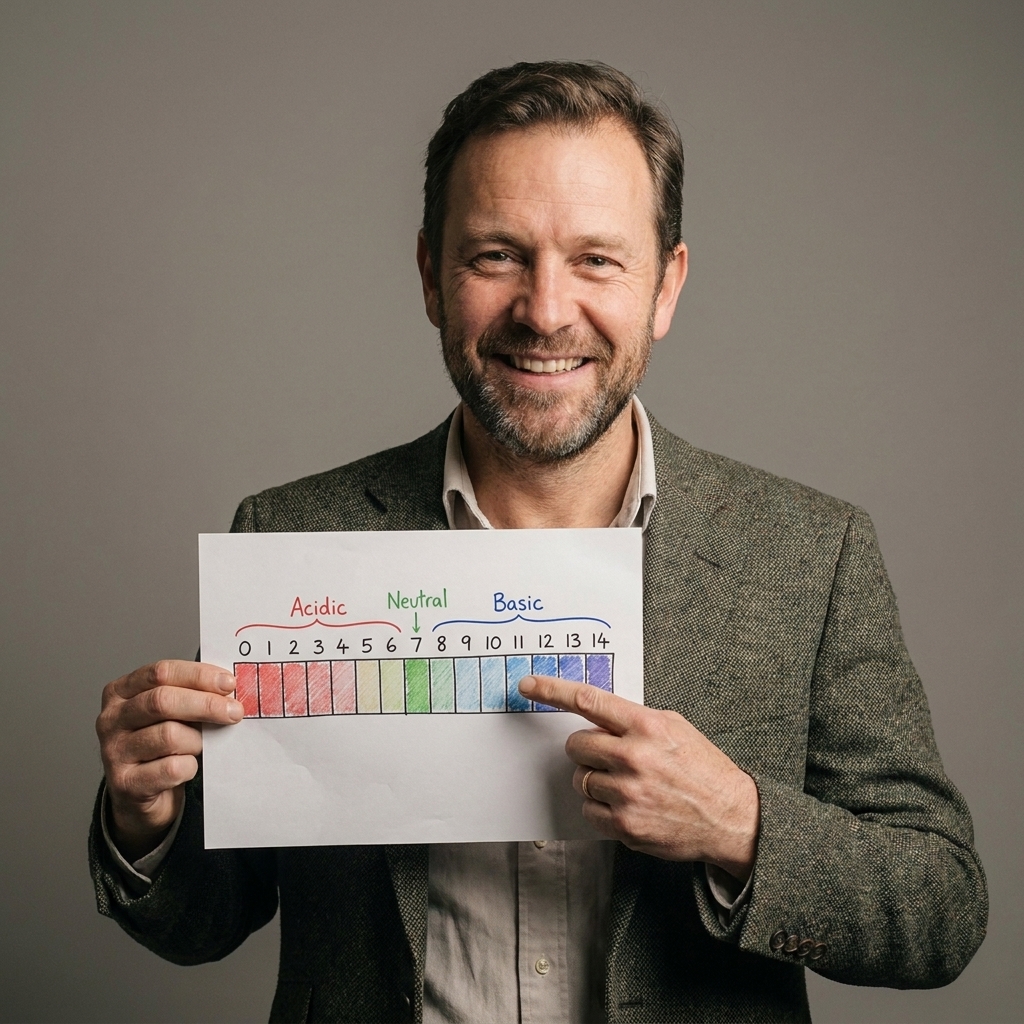
If you want a simple mental picture, the pH scale is often shown from 0 to 14 with acids on the low end and bases on the high end. Neutral is around 7 at 25°C. In more concentrated solutions, pH can be below 0 or above 14, but 0 to 14 is the common classroom scale.