One of my favorite things about physics is that it is not locked away in a lab. It is in your kitchen, your sock drawer, and that slightly chaotic junk drawer we all pretend is “organized.” Below are five low-stress, high-aha experiments you can do with everyday items. Each one is safe, fast (most take 1 to 5 minutes), and designed to show a real physics idea you can feel happening.
Quick safety note: Adult supervision is smart for kids, and you should avoid doing these near breakables. For the hot water experiment, use heat-safe mugs and handle carefully. For the water-and-card trick, keep a hand near the card the first time until you trust your seal.
What you will explore
- Gravity and acceleration (why things fall the same way when air resistance is small)
- Friction (how surfaces and forces decide whether something slides or sticks)
- Air pressure (the invisible “ocean” of air pushing on everything)
- Thermodynamics (how heat moves and why temperature differences do surprising work)
- Inertia (how objects resist changes in motion)
1) The “same fall” test (gravity)
Big idea: When air resistance is small (or similar for both objects), objects fall with the same acceleration due to gravity.
You need
- Two objects with similar shape and surface area but different mass, like two same-size balls (rubber ball and a similar-size ball of clay), or two identical plastic bottles (one empty, one filled) with the caps on
- A chair or step stool (optional, for a higher drop)
Do this
- Hold both objects at the same height and in the same orientation.
- Drop them at the same time.
- Drop onto a hard surface (tile or wood) so the timing is easier to hear.
What you should notice
Most well-matched pairs land essentially together. That is gravity doing its beautifully consistent thing: the acceleration is about 9.8 m/s² near Earth’s surface, regardless of mass.
Make it more dramatic
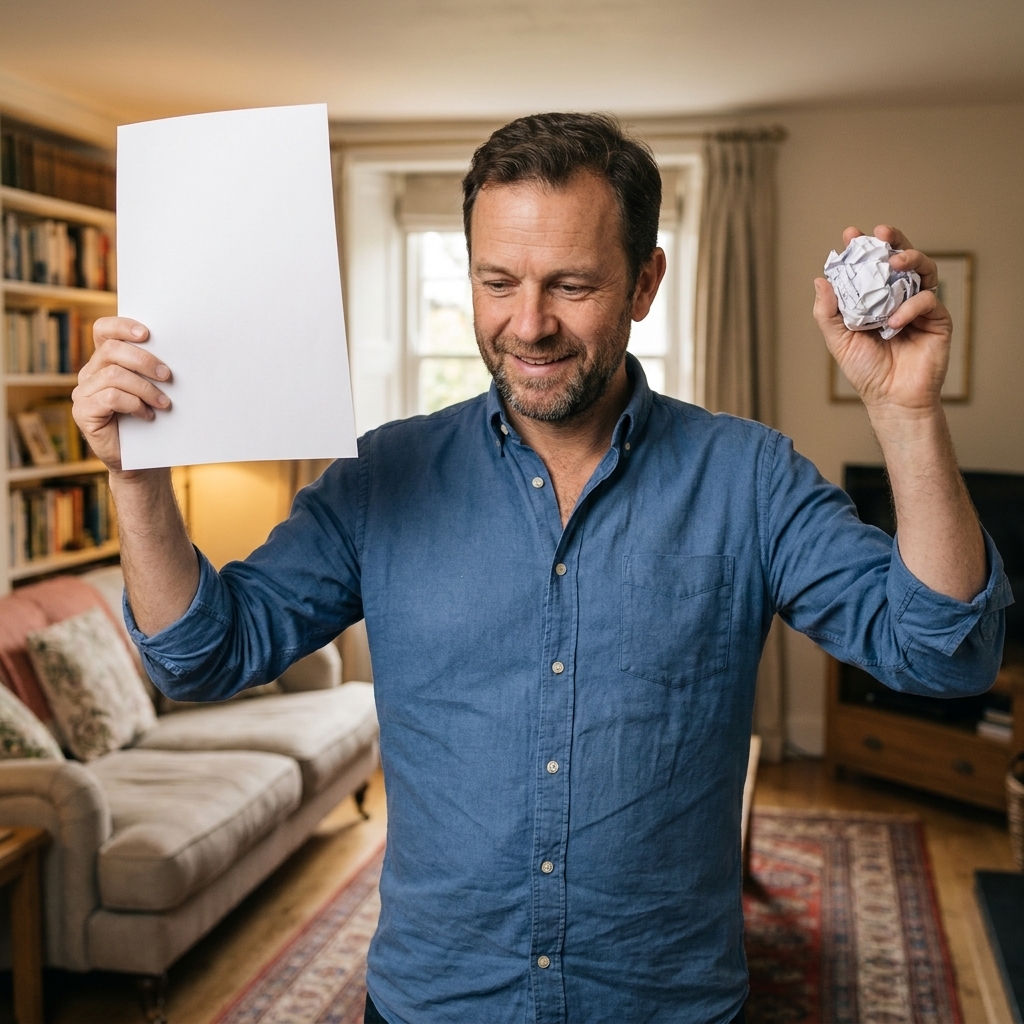
Now repeat with a flat sheet of paper and the same paper crumpled into a ball. The crumpled paper usually wins, not because it is “more affected by gravity,” but because it has much less air resistance relative to its weight.
Why it works
Gravity pulls on mass, but air pushes back through drag. A flat paper has a lot of area for air to shove against, so it falls slower. When you crumple it, you reduce drag dramatically, and gravity gets to show off more clearly.
2) Balloon hovercraft (friction)
Big idea: A thin cushion of air can reduce friction so much that objects glide like they are on ice.
You need
- A balloon
- The cap from a sports drink bottle, or a pop-top cap with a small opening
- A CD or DVD (old is fine)
- Tape or glue
Do this
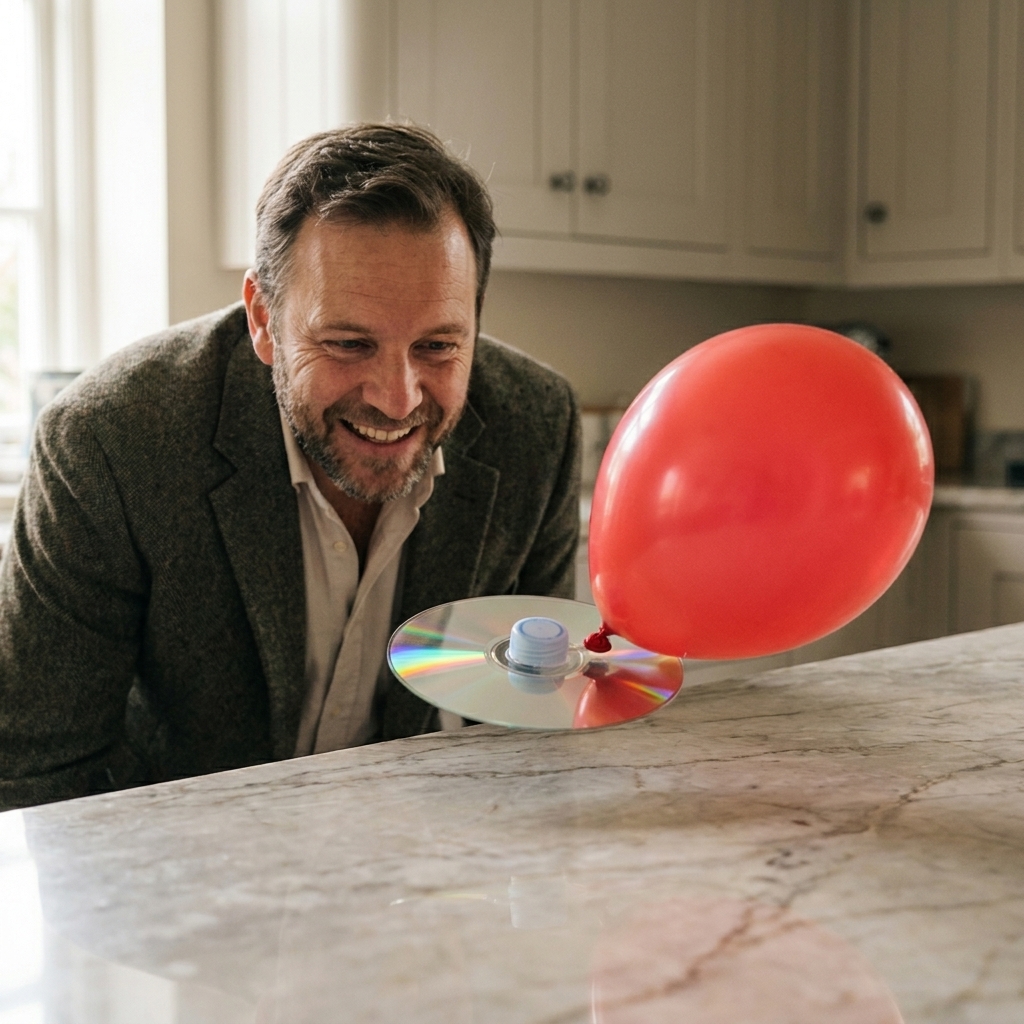
- Attach the bottle cap over the CD’s center hole, sealing around it with tape so air will not leak from the sides.
- Inflate the balloon and pinch the neck closed.
- Stretch the balloon opening over the cap (or tape it securely).
- Set it on a smooth surface, then release the balloon so air flows down through the hole.
What you should notice
The CD suddenly slides with very little push. It can coast far longer than you expect, especially on a countertop or tile floor.
Why it works
Friction depends on how strongly two surfaces press together and how they interact microscopically. The escaping air forms a thin film that reduces contact between the CD and the table, so friction drops a lot. It is like a tiny air hockey table that moves with the puck, not because friction vanishes, but because contact (and therefore friction) is greatly reduced.
Try this next
- Test different surfaces: carpet, wood, tile.
- Add a coin on top. Does it glide the same? You are changing the normal force and testing whether the air cushion can still support the load.
3) The index card trick (inertia)
Big idea: Objects resist changes in motion. If you yank a surface out quickly, the object above it tends to stay put.
You need
- An index card or a stiff piece of cardstock
- A clear glass (or sturdy cup) with a flat top rim
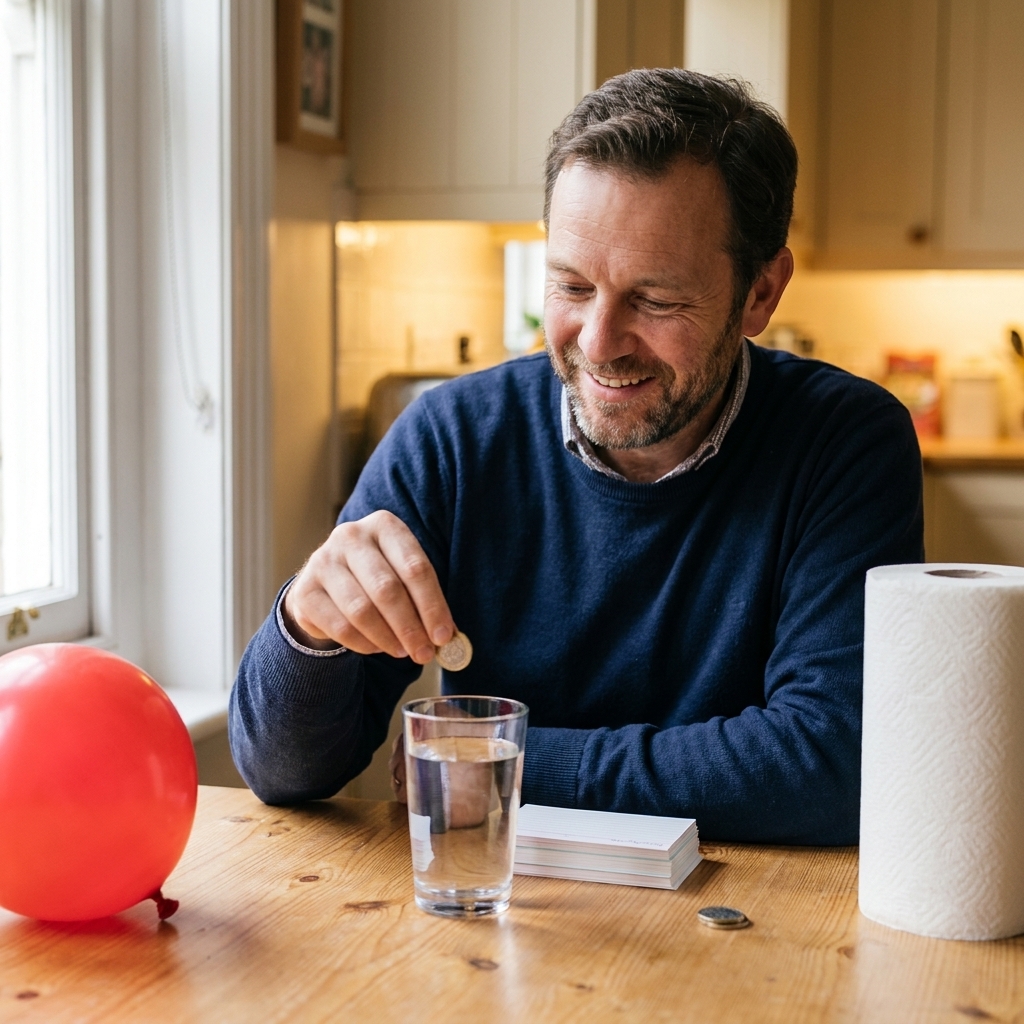
- A coin
Do this
- Place the index card on top of the glass.
- Put the coin on the index card, centered above the glass opening.
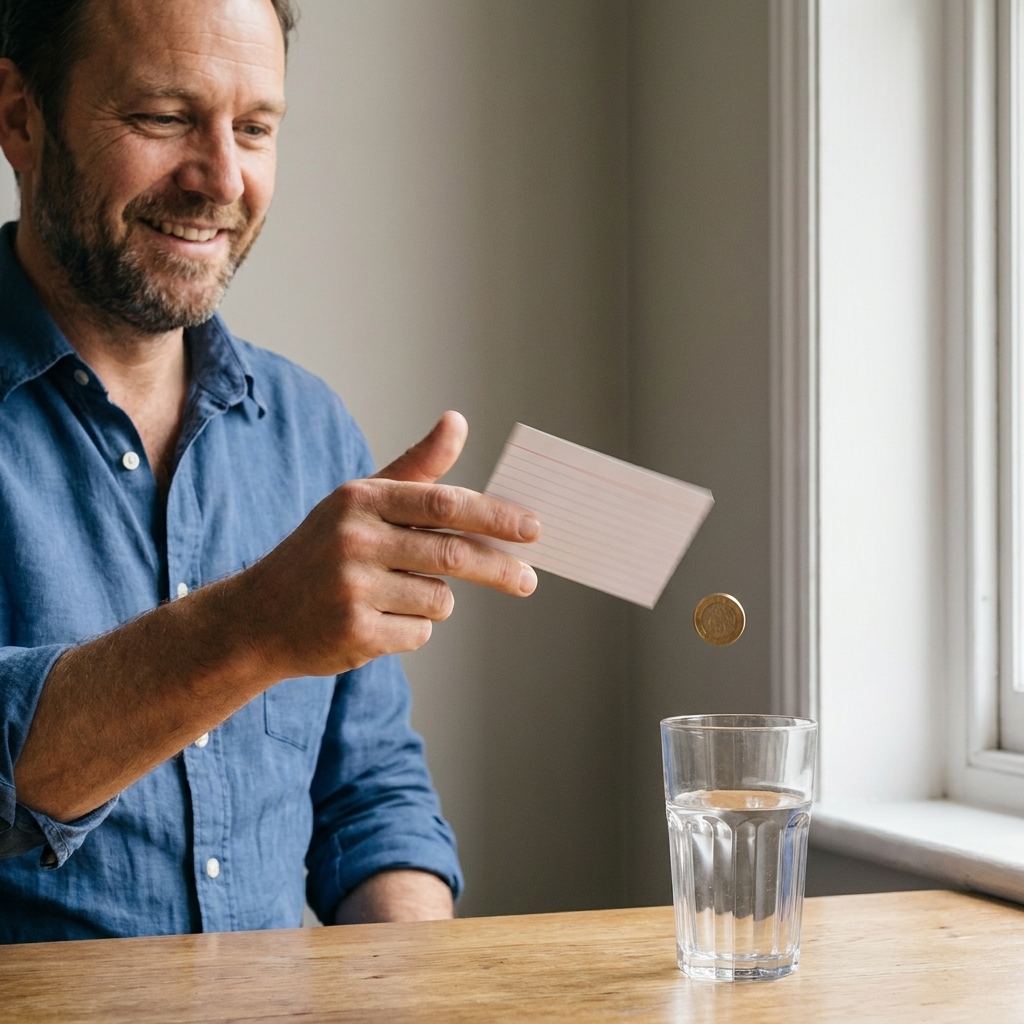
- Flick the card sharply sideways with your finger.
What you should notice
The card shoots out, and the coin drops straight down into the glass like it had a tiny trapdoor moment.
Why it works
Your flick gives the card a big horizontal acceleration. The coin experiences only a small horizontal friction force from the card, often not enough to accelerate it much before the card is gone. Gravity takes over and pulls the coin down into the glass.
Tuning tips
- If the coin flies sideways, flick faster or use a smoother card.
- If the card barely moves, use a firmer, quicker snap.
4) Hot water balloon (thermo)
Big idea: Heating a gas increases the average kinetic energy of its molecules. With roughly constant external pressure (and an elastic balloon that can expand), the gas volume increases until it reaches a new equilibrium.
You need
- An empty plastic bottle (dry inside)
- A balloon
- A bowl or mug
- Hot water (not boiling), plus optional cold water for comparison
Do this
- Stretch the balloon a few times to make it easier to inflate.
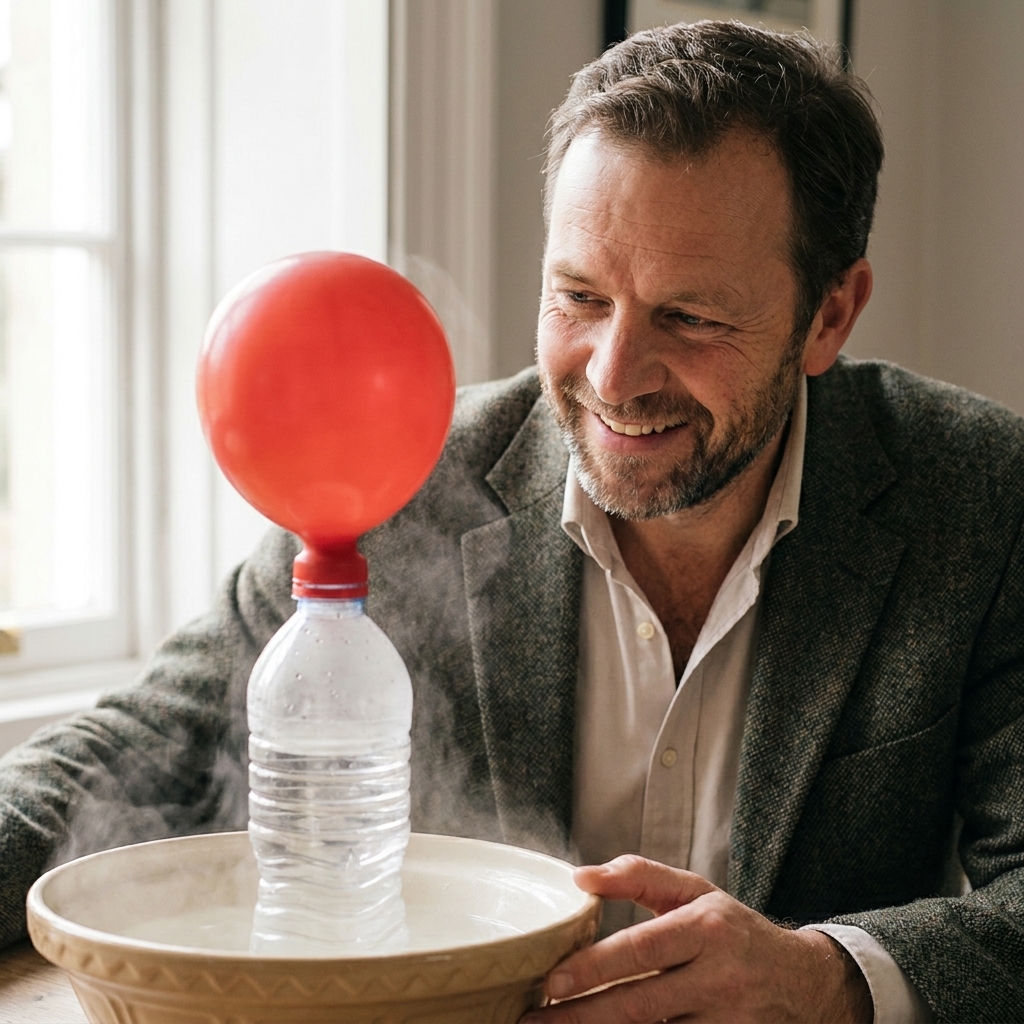
- Put the balloon over the bottle’s mouth to form a good seal.
- Place the bottle into a bowl of hot water so the bottom half is warmed.
- Watch the balloon over the next minute or two.
What you should notice
The balloon gradually puffs up. Swap the hot water for cold water and it shrinks again.
Why it works
When the air inside the bottle warms, its molecules move faster and collide with the balloon more often and more forcefully. The balloon expands until the pressure inside balances the outside air pressure plus the balloon’s elastic tension. Also, a small part of the effect can come from the balloon itself warming and becoming more flexible, which makes expansion easier. Either way, you are watching temperature changes do real work.
Make it a mini-investigation
- Time how long it takes to inflate to a certain size with warm water versus hotter water.
- Try bottles of different sizes. More air volume can mean more noticeable inflation.
5) The upside down water cup (air)
Big idea: Air pressure can support water against gravity when a sealed system prevents air from entering.
You need
- A clear glass
- Water
- A stiff card (index card, postcard, or thin plastic card)
- A sink or a tray (do this where a spill is okay)
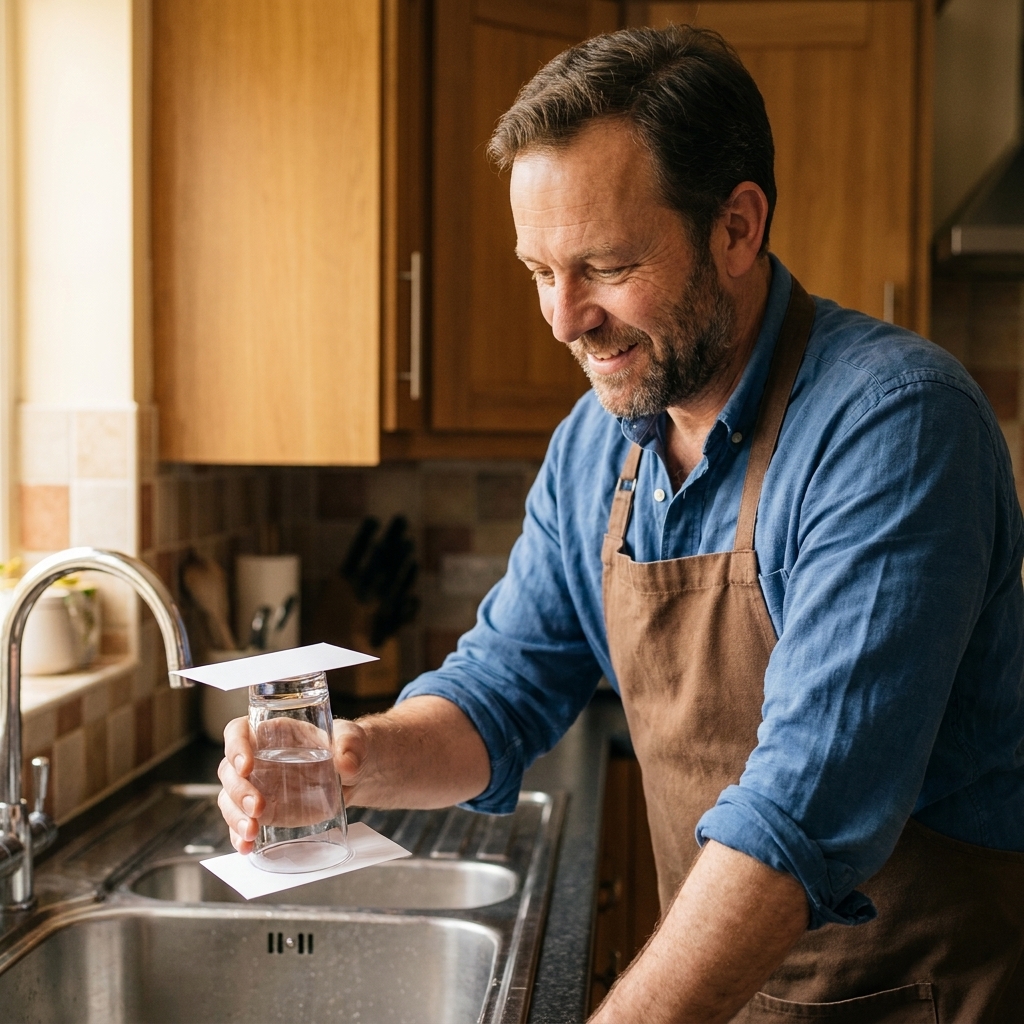
Do this
- Fill the glass nearly to the brim with water.
- Place the card flat on top and press gently to make a seal.
- Holding the card in place, flip the glass upside down over the sink.
- Slowly let go of the card, keeping one hand close underneath it the first time.
What you should notice
The card usually stays put, holding the water inside the inverted glass. It feels like physics is cheating. It is not.
Why it works
When the glass is inverted and sealed, water tries to fall, but that would create a low-pressure region inside the glass. The higher air pressure outside pushes up on the card more strongly than the water pushes down, so the card stays in place. A tiny bit of leaking can let air in and break the effect, which is why a good seal matters.
Common troubleshooting
- It spills immediately: Use a stiffer card, press out air bubbles, and keep the rim clean for a better seal.
- It works then fails: Small leaks slowly equalize pressure. Try a smoother card or a glass with a flatter rim.
Make it feel like real science
If you want to level these up from “cool trick” to “tiny home lab,” do one simple thing: change one variable at a time and write down what happened.
- Match shapes carefully and change only mass (gravity test).
- Test surfaces and added mass (hovercraft).
- Try different coins or different flick speeds (inertia trick).
- Use warm versus hotter water and time inflation (thermo balloon).
- Swap card materials and glass shapes (air pressure glass).
Those little notes are how science turns wonder into understanding. Also, they are how you convince your future self you did not imagine the results.
FAQ
Are these experiments safe for kids?
Yes, with supervision. The only one involving heat is the bottle-and-balloon thermodynamics demo. Use hot tap water, not boiling water, and handle the container carefully.
Why do heavier things not fall faster?
In everyday life, air resistance often confuses the story. But gravity accelerates objects at the same rate regardless of mass. When drag is small compared to weight, the “same fall” behavior becomes obvious. The trick is choosing objects with similar shape so drag does not dominate.
What if I do not have a CD for the hovercraft?
You can try a smooth, lightweight plastic lid or a sturdy round piece of plastic with a central hole, but CDs tend to work well because they are rigid, smooth, and consistently shaped.
A final note from a former classroom
When I taught high school physics , the best days were never the ones where I talked the most. They were the ones where students did something, saw something weird, then asked “Wait, why?” If you do one of these experiments and catch yourself grinning at the result, congratulations. You just had the same moment. If Quark my golden retriever were here, he would probably try to eat the index card, but the enthusiasm would be the same.