Quantum computing has a reputation for being the “you need a PhD to enter” corner of technology. I get it. The vocabulary alone can feel like walking into a physics classroom mid-lecture.
But here is the good news: the core ideas are simple enough to hold in your head. The hard part is accepting that the universe does not always behave the way our everyday intuition wants it to. Quantum computers are machines that lean into that weirdness on purpose, the way a sailboat leans into wind.
In this guide, we will build a beginner-friendly mental model of what quantum computers are, what problems they are good at, and where the hype ends and the real engineering begins.
Why classical computers hit limits
Classical computers are brilliant at many things because they reduce almost everything to a long sequence of tiny yes-or-no decisions. Under the hood, your laptop stores information in bits that are either 0 or 1, then processes them with logic gates.
That approach scales incredibly well, but it runs into a wall when problems explode in complexity. A classic example is simulating molecules. Chemistry is fundamentally quantum, and as molecules grow, the number of quantum states you need to track grows so fast that even supercomputers struggle.
So the question becomes: what if we built a computer that speaks the universe’s “native language” for atoms and electrons?
Bits vs qubits
A qubit is a quantum version of a bit. It can be built from different physical systems: superconducting circuits, trapped ions, photons, even defects in diamond. Regardless of the hardware, the concept is the same: a qubit can exist in a superposition of basis states (often labeled 0 and 1), and when you measure it you get one definite outcome.
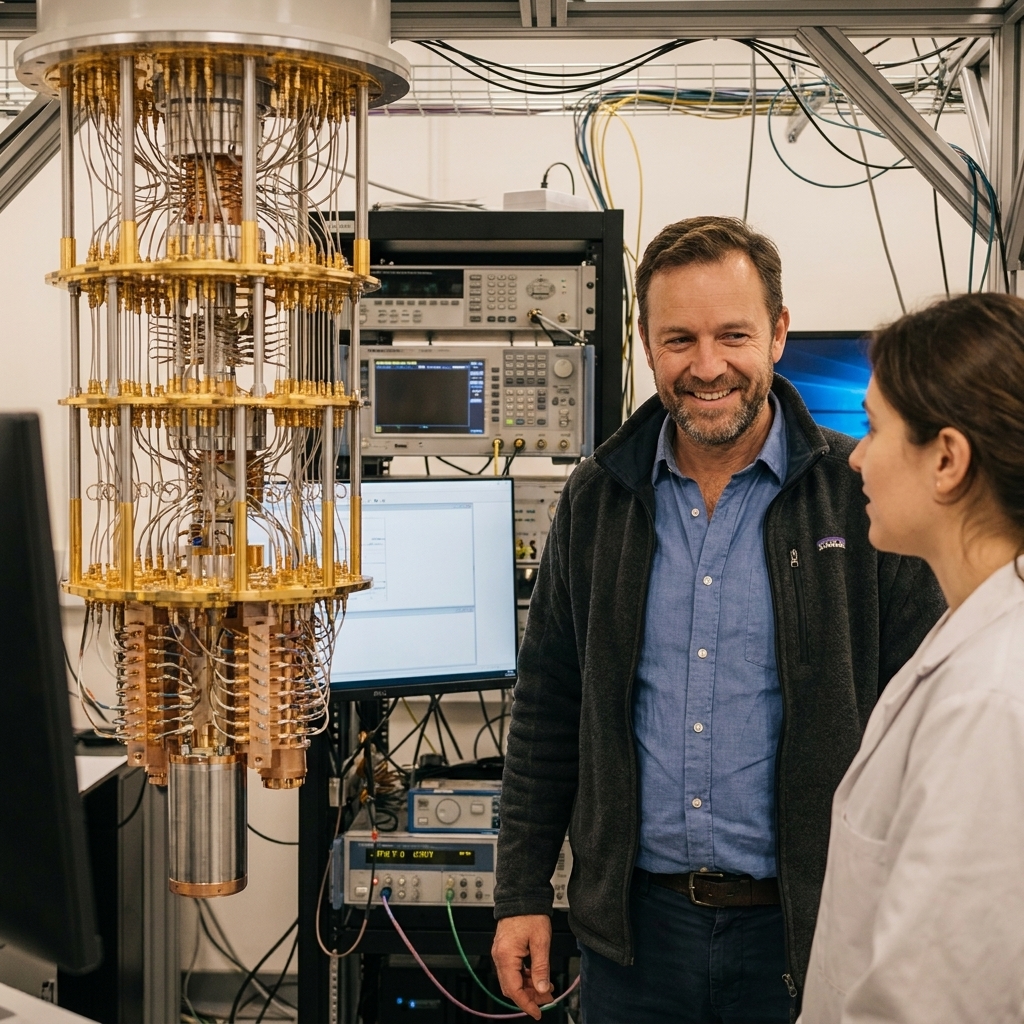
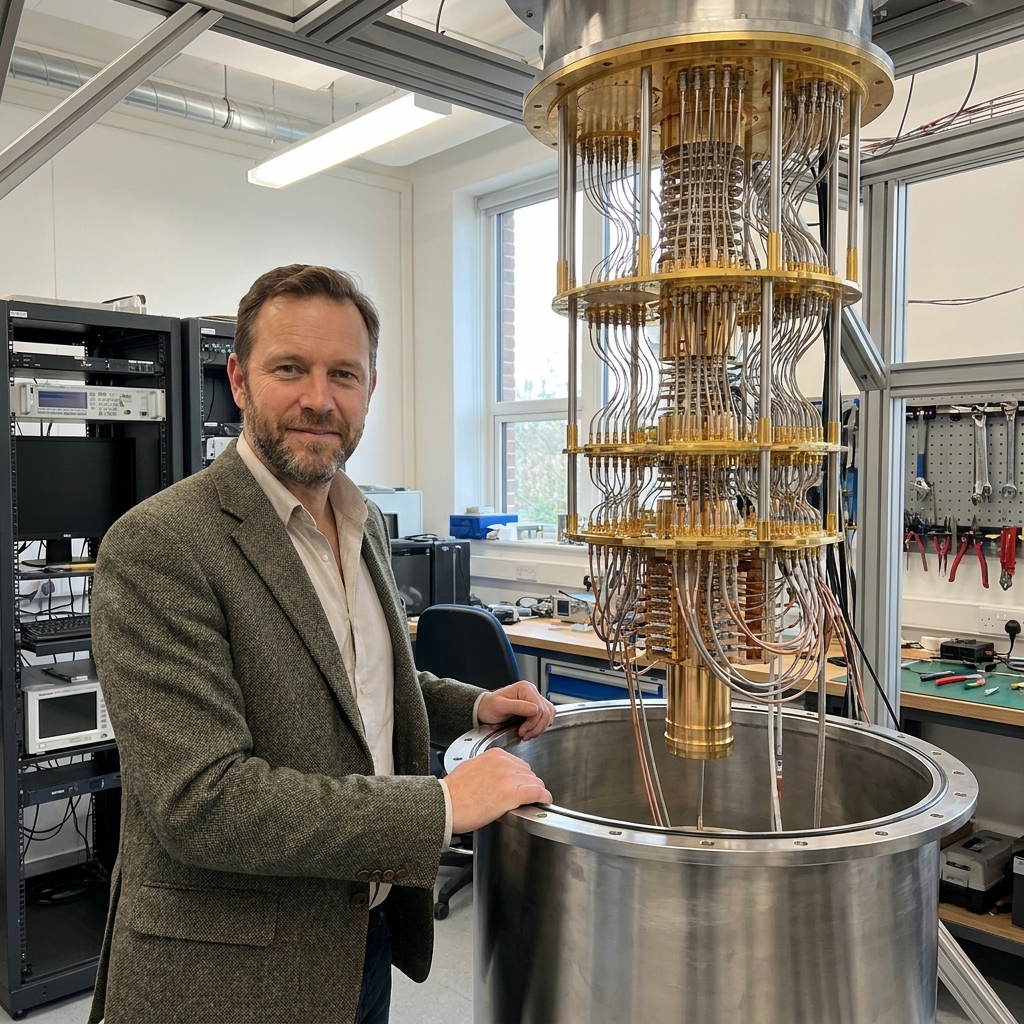
One practical detail that helps connect the buzzwords to the hardware: many superconducting qubits live in dilution refrigerators because extreme cold reduces thermal noise and helps preserve delicate quantum behavior.
Superposition, in plain language
In a classical world, a coin is either heads or tails. In the quantum world, a qubit is more like a coin spinning in the air: it is not committed to heads or tails until you look. Before measurement, it has a probability of becoming 0 and a probability of becoming 1.
One important clarification: this is not just ignorance, like “we do not know what it really is.” The qubit is genuinely described by probability amplitudes until measurement forces a single classical result.
Important nuance: superposition is not “the qubit is secretly both values in the way you would store two files.” It is one quantum state that only shows up as a definite 0 or 1 when measured.
Entanglement: the linked fate effect
Entanglement is where quantum really stops being polite. Two qubits can be prepared so that measurements produce outcomes that are strongly correlated. Measuring one can instantly tell you something about the other, even if they are far apart, depending on how the pair was prepared and which measurement you choose.
It is not a faster-than-light message. It is a shared state that only becomes definite when measured.
If superposition is like a spinning coin, entanglement is like two spinning coins that always land in coordinated ways. You do not control the outcome, but the relationship between outcomes is stronger than classical physics allows.
How quantum computes
Quantum computers use operations called quantum gates to shape probability amplitudes (you will sometimes hear the looser phrase “probability waves”). Instead of flipping bits, gates rotate and entangle qubits, steering the final measurement toward useful answers.
A helpful mental model is this:
- Classical computing is like trying many paths one after another, very quickly.
- Quantum computing is like setting up waves across many paths at once, then using interference so that wrong paths cancel out and right paths build up.
That said, not every quantum speedup is neatly explained as “path interference.” But interference is a common theme in why certain quantum algorithms can outperform classical ones.
This is why you will often hear that quantum computers are not “faster at everything.” They are faster at certain categories of problems where interference and structure can be exploited.
The catch: measurement and noise
If you measure qubits too early, you collapse the quantum state and lose the advantage. Most quantum algorithms are designed to delay measurement until the end for exactly this reason.
If you wait too long, the environment “nudges” the qubits and they lose their quantum behavior.
That loss is called decoherence, and it is the main villain of practical quantum computing. Heat, stray electromagnetic fields, imperfect control pulses, and tiny material defects can all scramble qubit states.
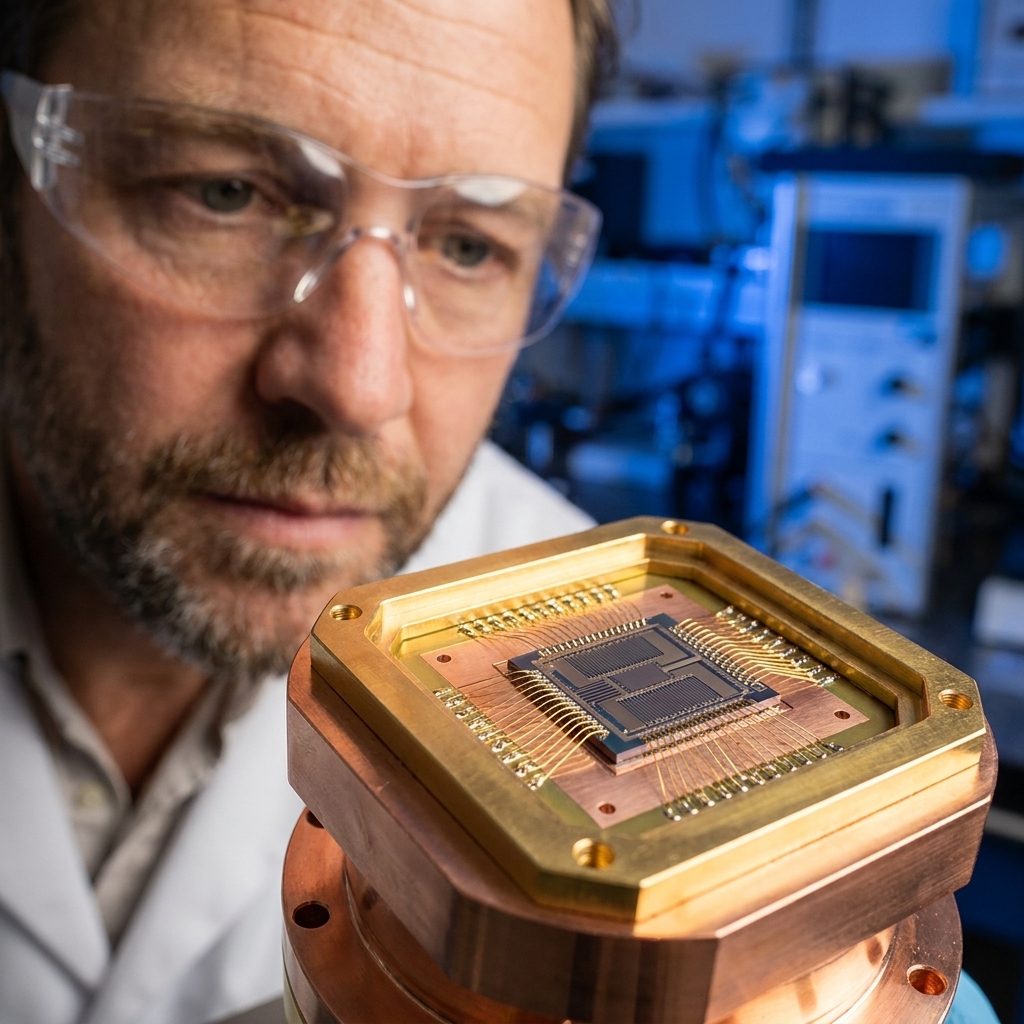
Today’s machines are often described as NISQ devices: Noisy Intermediate-Scale Quantum computers. They can run small circuits, but errors add up quickly, which limits what they can do reliably.
What quantum computers are good at
Quantum advantage is not about replacing your laptop. It is about tackling a few specific problem types that get ugly for classical machines.
You might also hear the term quantum supremacy, which is a more specific milestone: a quantum device doing a particular task that is impractical for classical computers, even if that task is not useful. People increasingly prefer “advantage” when they mean something that is both hard for classical machines and meaningfully valuable.
1) Chemistry and materials
This is the most natural fit because molecules are quantum objects. In the long run, better molecular simulation could help with:
- Battery materials that store more energy or charge faster
- Fertilizer production with lower energy use
- Drug discovery by modeling how molecules bind to targets
Classical computers already do a lot here, but quantum could expand the size and accuracy of what we can model.
2) Optimization problems
Optimization is the “find the best needle in a haystack of possibilities” family of problems. Examples include:
- Routing delivery fleets and reducing fuel use
- Scheduling in factories or hospitals
- Balancing portfolios under constraints
Some quantum approaches aim to speed up certain optimization tasks, though it is an active research area to determine when the quantum win is clear and when classical methods still dominate.
3) Cryptography and security
Quantum computing is famous for one algorithm in particular: Shor’s algorithm, which could factor large numbers efficiently on a sufficiently large, fault-tolerant quantum computer. That matters because some widely used public-key cryptography relies on factoring being hard for classical computers (notably RSA).
It is not only RSA. Shor’s algorithm also threatens elliptic-curve cryptography (ECC) by solving the related discrete logarithm problem efficiently on the right kind of quantum hardware.
Two important clarifications:
- Breaking common encryption at scale would require quantum hardware far beyond what exists today.
- There is a strong push toward post-quantum cryptography, new algorithms designed to resist both classical and quantum attacks.
4) Quantum simulation for science
Beyond chemistry, quantum computers may help simulate other quantum systems: exotic phases of matter, high-temperature superconductors, and models in particle physics. Think of it as using one controlled quantum system to study another.
5) Sensing and metrology
Not all quantum tech is “quantum computing,” but it is worth mentioning: quantum effects can make extremely sensitive sensors for timekeeping, gravity, and magnetic fields. For example, atomic clocks improve precision timing, and quantum magnetometers can enable very sensitive magnetic field measurements used in certain research and medical contexts.
Near term vs long term
Near term: hybrid workflows
In the next few years, the most realistic pattern is hybrid computing: classical computers do most of the work, and quantum processors handle specific subroutines where they might help.
To set expectations correctly, most near-term results are exploratory and problem-specific. The goal is often to learn what is practical, not to declare a universal win. Early progress is most likely in:
- Chemistry prototypes for small molecules (often framed around VQE-style methods)
- Materials property estimation in narrow domains
- Optimization experiments where constraints are structured and the quantum circuit is short (often discussed alongside QAOA-style approaches)
Long term: fault-tolerant quantum
The big leap is quantum error correction. Error-corrected machines use many physical qubits to create a smaller number of highly reliable “logical” qubits. This is the level needed for large-scale algorithms like Shor’s to matter broadly, and for many other deep circuits that are out of reach in the NISQ era.
That road is engineering-heavy: better qubits, better control, better fabrication, and lots of clever mathematics to detect and correct errors without destroying the quantum state.
Common myths
Myth: “Quantum computers try every answer at once.”
Reality: quantum states can represent many possibilities, but you only get one measurement result. The advantage comes from interference shaping probabilities, not brute-force trying every answer.
Myth: “Quantum computers will make classical computers obsolete.”
Reality: classical machines are phenomenal and will stay that way. Quantum computers are specialized tools, more like adding a new instrument to the orchestra than replacing the whole band.
Myth: “Quantum means instant results.”
Reality: even if a quantum algorithm offers a speedup, it still requires careful setup, repeated runs, and error management. Physics is powerful, not magical.
A small toolbox
If you want a sturdy beginner mental model, keep these three ideas on your desk:
- State: a qubit’s full information is a quantum state, not just 0 or 1.
- Control: gates are how we sculpt that state through rotations and entanglement.
- Readout: measurement gives a classical result, and we usually repeat many times to estimate probabilities.
That is the rhythm: prepare, evolve, measure, repeat.
FAQ
Do I need advanced quantum mechanics?
No. To follow the big picture, you mainly need comfort with probability, waves, and the idea that measurement matters. The math becomes important if you want to design algorithms or analyze hardware, but curiosity comes first.
How many qubits do we need?
It depends on the task and on error rates. Some experiments are interesting with tens to hundreds of qubits, but many transformative applications likely require error-corrected logical qubits, which could mean thousands to millions of physical qubits depending on hardware quality.
Can quantum computers help with AI?
Possibly, especially for certain linear algebra and sampling tasks, but this is still a developing area. Near-term impact is more likely in scientific computing and chemistry than in replacing today’s mainstream machine learning pipelines.
Should I worry about my passwords right now?
Not panic-worthy, but it is sensible to pay attention. The practical response is adopting and supporting post-quantum cryptography as standards roll out, especially for organizations that need long-term confidentiality.
Explore further
If you are the kind of person who likes to learn by tinkering, there are beginner-friendly quantum programming environments (often browser-based) that let you run small circuits on simulators or limited real hardware. Start with the goal of understanding how superposition and entanglement show up in measurement statistics, not with the goal of “beating” your laptop.
Quantum computing is still a young field, which is part of the fun. We are watching a new kind of machine learn how to exist in the real, noisy universe, one carefully cooled qubit at a time.