When I taught physics, I used to tell my students that classical physics is like a trusty road map: if you know where you are and how fast you are going, you can predict where you will be next. Quantum mechanics is more like checking the weather: you get solid odds, patterns, and forecasts, but not a single guaranteed outcome for one exact raindrop.
Both frameworks are “right” in their home territory. Classical physics shines for baseballs, bicycles, bridges, and planets. Quantum mechanics runs the show for electrons, atoms, and the tiny building blocks of matter and light. The fun part is seeing why we needed a new rulebook, and what changes when we cross from the human-scale world into the atomic one.

The big idea: two rulebooks for two scales
Classical physics is the umbrella for Newton’s laws of motion , Maxwell’s electromagnetism, and thermodynamics. It treats objects as having definite properties, and for many idealized systems it predicts outcomes with near certainty.
One important nuance: classical laws are typically deterministic, but that does not always mean predictable in practice. Weather, turbulence, and chaotic systems can be exquisitely sensitive to tiny uncertainties in starting conditions, so long-term prediction becomes effectively impossible even though the underlying rules are not probabilistic.
Quantum mechanics is the framework developed in the early 20th century to explain phenomena classical physics could not. It describes nature in terms of probabilities, wave-like behavior, and discrete (quantized) energy levels in many important systems.
Think of it this way: classical physics is what you get when the quantum “graininess” is too tiny to matter. Quantum mechanics is what you must use when that graininess becomes the whole story. In fact, classical behavior is an excellent approximation that emerges from quantum rules in the right limit, not a separate universe.
Key differences at a glance
- Determinism vs. probability: Classical laws are usually deterministic; quantum theory predicts probabilities for measurement outcomes.
- What counts as a “state”: Classical objects can be modeled as having definite position and velocity; quantum systems are described by a wavefunction that encodes probability amplitudes.
- Measurement: In classical physics, measuring can often be treated as passive; in quantum mechanics, measurement and disturbance are tied to what you can know, especially for incompatible observables.
- Energy and matter: Classical energy is treated as continuous; quantum energy is often quantized in bound systems and normal modes.
- Behavior: Classical objects behave like particles; quantum objects can show particle-like and wave-like behavior depending on the experiment.
Classical physics: the world of certainty (most of the time)
Determinism and trajectories
In classical mechanics, if you know an object’s starting position and velocity, Newton’s laws tell you its future motion. This is why engineers can predict how a bridge will flex under load, or why astronomers could predict the return of Halley’s Comet long before we had computers.
Continuous quantities
Classical physics usually treats physical quantities as smoothly variable. A car can have any speed, a wave on a pond can have any amplitude, and an object can take any energy value.
Where classical physics is strongest
- Everyday motion: projectiles, vehicles, sports
- Planetary and satellite orbits (with small corrections from relativity)
- Circuits and electromagnetism at ordinary scales
- Heat engines, weather patterns (as classical fluids), many materials problems

Quantum mechanics: the rulebook for the tiny
Probability is not a bug, it is the feature
In quantum mechanics you do not usually predict a single outcome. You predict the probability of different outcomes. If you repeat the same experiment many times, the overall pattern is extremely reliable, even if each individual result is not.
This is a subtle but crucial shift: quantum mechanics is not saying “we are ignorant, so we guess.” In the standard formulation, the theory itself gives only probabilities for outcomes, even when you have fully specified the quantum state.
One concrete example: send electrons through a Stern–Gerlach device that measures spin along a chosen axis. Each electron hits one of two spots, not a smeared continuum. You cannot predict which spot for a single electron, but you can predict the statistics across many runs.
Wavefunctions and superposition
A quantum system is described by a wavefunction (often written as ψ), which tells you the probability structure for finding the system in various states. Before measurement, quantum systems can exist in a superposition
, meaning multiple possibilities coexist in a mathematically precise way.
If that sounds mystical, here is a grounded way to hold it: superposition is a statement about how quantum probability amplitudes combine, producing interference patterns that classical probabilities cannot.
Quantization: nature’s “stair steps”
One of the earliest quantum clues was that atoms absorb and emit light at specific frequencies, not a continuous rainbow of possibilities. In quantum mechanics, many bound systems have allowed energy levels like rungs on a ladder. Electrons in atoms occupy certain rungs, and when they make a transition between rungs they emit or absorb a photon with a specific energy.
Uncertainty: not just measurement clumsiness
The Heisenberg uncertainty principle is often summarized as: you cannot know a particle’s position and momentum with unlimited precision at the same time. The important part is why. It is not primarily about bad instruments. It is built into how quantum states work. A state that is tightly localized in space necessarily contains a spread of momenta, and vice versa.
Why classical physics breaks: the experiments that forced a new theory
Quantum mechanics did not appear because physicists got bored of Newton. It appeared because nature kept handing us test results that classical ideas could not explain.
Blackbody radiation: the divergence that experiments refused
Classical theory (via the Rayleigh–Jeans law) implied that a hot object should emit more and more energy at higher frequencies, blowing up to an unphysical infinity. Experiments did not show that. The fix was radical for its time: energy exchange comes in discrete chunks. That was one of the first steps toward quantum theory.
The photoelectric effect: light acting like particles
Shine light on certain metals and electrons pop out. Classical wave theory said brighter light should eventually eject electrons regardless of color. But experiments showed something sharper: below a threshold frequency, no electrons come out, no matter how bright the light is. The best explanation is that light arrives in packets called photons, and each photon must carry enough energy to liberate an electron.
Electron diffraction: matter acting like waves
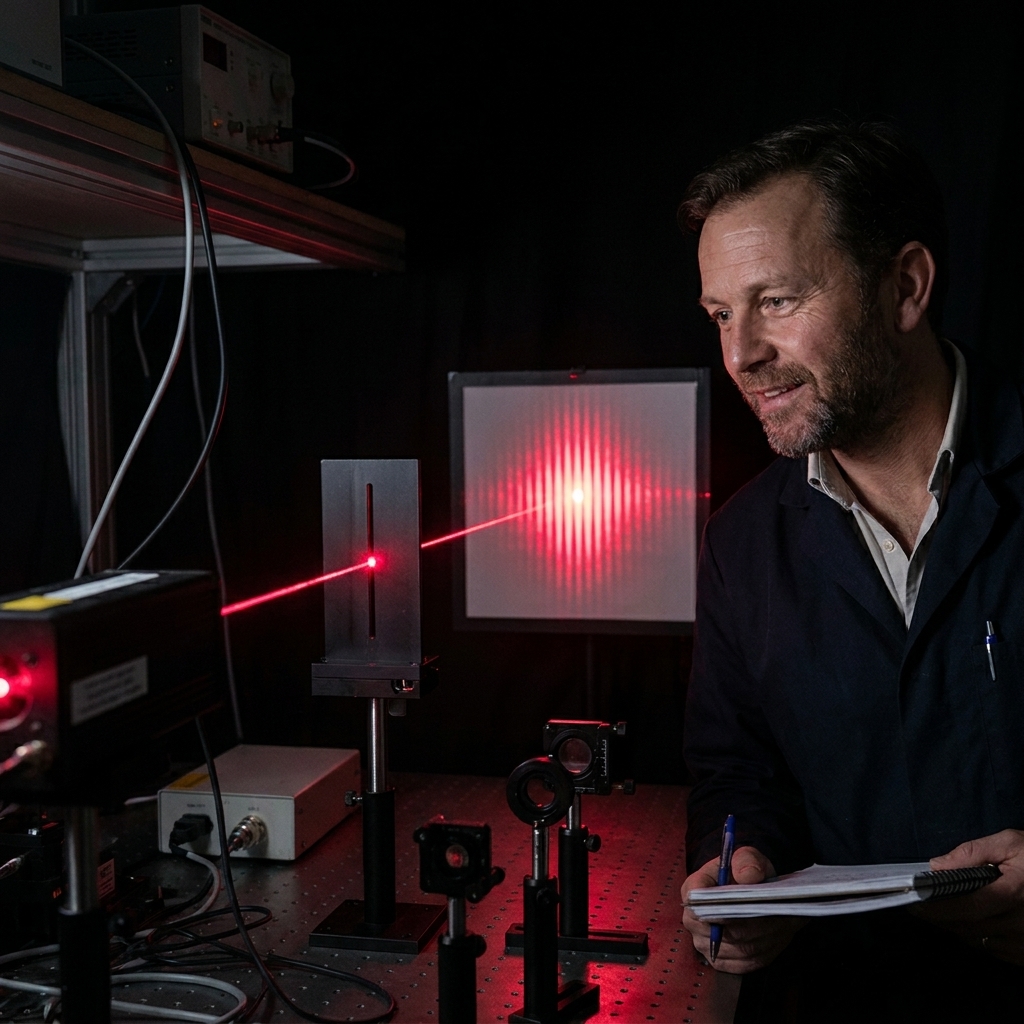
Electrons can produce interference patterns, a behavior we associate with waves. This is not metaphorical. It is experimentally observed. At the quantum scale, the particle versus wave distinction becomes dependent on how you probe the system.
Measurement: where the two worlds feel most different
In classical physics, measurement is conceptually passive: you can imagine reading off a speedometer without changing the car’s speed. In quantum mechanics, measurement is intertwined with the system because you are interacting with something tiny using something else physical, like photons or fields.
This leads to a practical rule: quantum theory predicts probabilities for different measurement outcomes, and the act of measurement yields one definite result. Not every measurement causes a dramatic disturbance, but whenever you ask about incompatible properties (like precise position and momentum), there is a built-in tradeoff in what the world can consistently give you.
If classical physics is a story about objects having properties, quantum mechanics is a story about interactions revealing properties.
When people say “quantum is weird,” it is often because our everyday intuition is built from classical-scale experiences. Quantum mechanics is not weird in the sense of being sloppy. It is weird in the sense of being different from what our senses evolved to expect.
So when do you actually need quantum mechanics?
Most of the time, you do not. A basketball does not need a wavefunction in any useful way because its quantum effects average out unbelievably fast and the uncertainties are astronomically tiny compared to the ball’s size.
Use classical physics when
- Objects are large compared to atoms
- You can ignore discrete energy levels
- Probabilistic effects wash out in bulk matter
You need quantum mechanics when
- You are dealing with atoms, molecules, electrons, or photons directly
- Discrete energy levels matter (spectra, lasers, semiconductors)
- Interference or tunneling shows up
- Entanglement matters, meaning correlations between parts of a system that cannot be reproduced by any classical “shared hidden instructions” story
That last one, entanglement, is not just a philosophical twist. It is a measurable pattern of correlations, and it is the ingredient behind quantum cryptography and much of the excitement around quantum computing.

Where quantum rules quietly power your daily life
Quantum mechanics can sound like it belongs only in particle accelerators and sci-fi novels. But you are surrounded by quantum technology.
- Semiconductors and transistors: Modern computing relies on electron behavior in solids, band gaps, and quantum statistics.
- LEDs and lasers: These depend on discrete energy transitions in materials.
- MRI machines: Magnetic resonance is rooted in quantum properties of nuclei and their interaction with magnetic fields.
- Solar panels: Photon absorption and electron excitation are quantum at heart.
Classical physics is still essential for designing and scaling these technologies, but quantum mechanics supplies the “why it works at all” foundation.
Common misconceptions (and the cleaner version)
“Quantum mechanics replaces classical physics.”
Not exactly. Quantum mechanics contains classical physics as an approximation in the right limit. For large systems and everyday conditions, quantum predictions converge to classical ones.
“Quantum means anything can happen.”
Quantum mechanics allows multiple outcomes, but not unlimited outcomes. It is tightly constrained by conservation laws, symmetries, and the structure of the system. It is probabilistic, not lawless.
“Uncertainty is just bad measurement.”
Better instruments help in many contexts, but the uncertainty principle is deeper than instrument error. It reflects how quantum states are constructed.
“Observation requires a human mind.”
In physics, “observation” means interaction with a measuring device or environment, not a conscious witness. A detector, a screen, or a stray photon can count as a measurement interaction.
Classical, quantum, and the bridge between them
One of my favorite takeaways to share is this: the universe is not split into two separate realities. There is one reality with different effective descriptions. Classical physics is a powerful, practical summary of what quantum mechanics looks like when enormous numbers of particles move together and the fine quantum ripples average out.
Physicists have names for parts of that bridge. The correspondence principle is the basic idea that quantum results must reproduce classical results in the appropriate limit. Decoherence helps explain why large objects do not display obvious superpositions in everyday life, because interactions with the environment rapidly suppress observable interference.
And when those ripples do not average out, when you are down in the realm of atoms, photons, and single electrons, quantum mechanics is not optional. It is the language nature uses.
If you remember one thing
Classical physics is a remarkably good approximation for big, warm, crowded systems. Quantum mechanics is the deeper rulebook that becomes unavoidable for the small, the cold, the isolated, or the carefully controlled.
FAQ
Is quantum mechanics more “accurate” than classical physics?
In principle, yes for microscopic systems. But “more accurate” depends on the problem. For a falling apple, classical physics is accurate enough and much simpler. For the color of neon light or how a transistor switches, classical physics misses the key mechanism.
Does quantum mechanics conflict with relativity?
Quantum mechanics (as used for atoms and materials) and Einstein’s special relativity both work extremely well. When you require quantum theory to be consistent with special relativity, the standard framework is quantum field theory. Gravity is the hardest piece to reconcile fully at the quantum level, which is why quantum gravity remains an open frontier.
What is the single biggest conceptual shift from classical to quantum?
The shift from definite trajectories to probability amplitudes. Classical physics is comfortable saying, “the particle is here, moving like this.” Quantum physics says, “here is the probability structure for what you will find when you look.”